

 English
 简体中文
 Español
 Deutsch
 Français
 Bahasa Indonesia
 Malaysia
 Português
 Русский язык
 بالعربية
 Kiswahili
 বাংলা
 Why Spray Polyurea Is Specified for Large-Area Projects
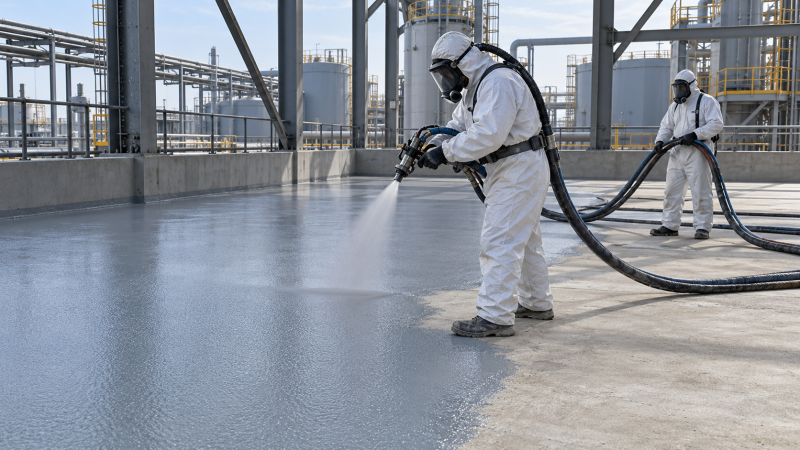
Spray-applied polyurea systems are selected for large-area applications—including tank linings, plaza decks, tunnel roofs, and containment basins—when project constraints demand rapid return-to-service, minimal jointing, and tolerance to variable ambient conditions. Unlike traditional liquid-applied membranes or sheet systems, polyurea forms a monolithic, elastomeric barrier in seconds after atomization, enabling continuous coverage across thousands of square meters without cold joints or seam vulnerabilities.
Key Technical Selection Criteria
Selection should begin with verification of system suitability against the intended exposure class:
- Chemical resistance profile: Confirm compatibility with anticipated service fluids (e.g., wastewater, process chemicals, de-icing salts) per current formulation data sheets.
- Thermal cycling range: Evaluate low-temperature flexibility and high-temperature stability limits relevant to geographic location and seasonal operation.
- Adhesion performance: Substrate type (concrete, steel, sprayed concrete, existing coatings) dictates primer selection and surface preparation method—abrasive blasting, grinding, or high-pressure water jetting may be required.
- Elongation and tensile strength balance: High-elongation formulations suit substrates prone to thermal or settlement movement; higher-tensile variants may be preferred for abrasion-prone traffic zones.
Application Planning for Scale
Large-area execution demands synchronized coordination—not just of spray crews, but of support functions:
- Equipment staging: High-pressure plural-component spray rigs require stable power supply, clean compressed air (if used for cleaning), and safe material feed paths. Mobile units must be positioned to minimize hose runs and pressure drop.
- Material logistics: Confirm the relevant technical requirement according to the selected system, project specification, and current technical documentation.
- Crew sequencing: Overlap patterns, wind direction, and curing speed affect edge control and inter-pass continuity. A minimum 3–5 minute window between passes is typical to avoid lifting or delamination at hot edges.
- Environmental monitoring: While polyurea is less humidity-sensitive than polyurethane, surface moisture, dew point, and substrate temperature still influence adhesion. Real-time logging is recommended for QA documentation.
Procurement and Supply Considerations
For distributors and procurement buyers, large-area projects require advance alignment on:
- Formulation consistency: Confirm batch-to-batch rheology and reactivity stability—especially when multiple production lots are scheduled across extended timelines.
- Supply requirements: Project-specific commercial and supply requirements should be confirmed directly for the selected product.
- Documentation package: Request current product documentation and any project-required test evidence.
- Order requirements: Confirm the relevant technical requirement according to the selected system, project specification, and current technical documentation.
Limits and Verification Requirements
While spray polyurea offers distinct advantages, its performance is not unconditional:
- It does not self-level like lower-viscosity coatings—surface texture reflects substrate profile and spray technique.
- UV stability varies significantly by formulation; non-pigmented or aliphatic versions are required for long-term exposed applications.
- Fire performance (e.g., flame spread, smoke density) is formulation-dependent and must be verified against local building codes—not assumed from generic polyurea classification.
- Crack-bridging capacity depends on film thickness, substrate movement rate, and ambient temperature during application—project-specific validation is advised where dynamic cracking is expected.
Next Steps for Project Teams
Before finalizing specification or placing orders, engineering procurement teams should request:
- Project-specific TDS and SDS aligned with the intended application environment;
- Primer compatibility matrix for all substrate types present on site;
- Recommended surface preparation protocols and acceptance criteria (e.g., ICRI CSP profiles, moisture content thresholds);
- Project-specific commercial and supply requirements should be confirmed directly for the selected product.
- Sample kits for trial application and adhesion testing under representative site conditions.
For technical inquiry or wholesale supply confirmation, contact YSROOM regarding the spray-applied polyurea waterproof coating.

