

 English
 简体中文
 Español
 Deutsch
 Français
 Bahasa Indonesia
 Malaysia
 Português
 Русский язык
 بالعربية
 Kiswahili
 বাংলা

 Why Choose Epoxy Floor Recoating Over Full Replacement?
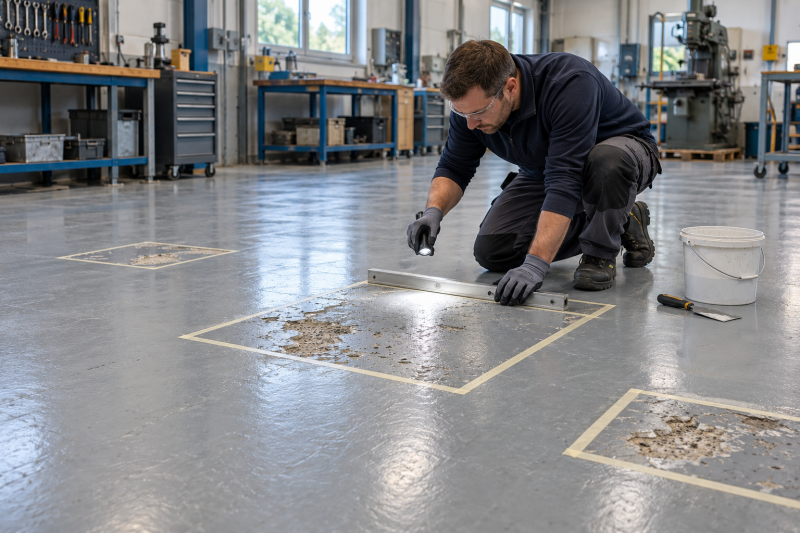
For operational continuity and cost control, epoxy floor recoating is often the preferred intervention when existing coated floors show wear but retain structural integrity. Unlike full removal and resurfacing, recoating minimizes downtime, avoids substrate demolition waste, and reduces labor-intensive preparation. However, success hinges on accurate assessment of the existing floor’s condition, adhesion stability, and compatibility with new epoxy layers.
Key Technical Evaluation Steps Before Recoating
Before specifying or applying any recoating system, conduct these three critical evaluations:
- Substrate Integrity Check: Confirm that the underlying concrete remains sound — free from delamination, spalling, or active moisture migration. Hollow-sounding areas or visible cracks may indicate deeper issues requiring repair prior to recoating.
- Existing Coating Adhesion Assessment: Request current product documentation and any project-required test evidence.
- Chemical & Contaminant Survey: Identify residual oils, curing compounds, sealers, or previous incompatible coatings (e.g., polyurethane over unmodified epoxy). Solvent wiping followed by water-break testing helps detect hydrophobic contamination affecting intercoat adhesion.
System Component Roles in Industrial Recoating
A complete epoxy floor recoating system typically includes three functional layers — each serving a distinct technical purpose:
Epoxy Floor Primer
The primer penetrates and bonds to both aged epoxy and exposed concrete, restoring uniform surface energy and improving interlayer adhesion. It must exhibit low viscosity and high wetting capability to bridge micro-defects and ensure cohesive integration with the existing surface. For workshops with intermittent moisture exposure, primers formulated with moisture-tolerant resins may be specified — though substrate moisture content should still be verified per project TDS.
Learn more about our epoxy floor primer formulation options and compatibility guidelines.
Epoxy Middle Coat
This layer provides thickness build, impact resistance, and crack-bridging capacity. In recoating applications, it compensates for surface irregularities and enhances load distribution across aging substrates. Fillers (e.g., quartz sand or silica) may be added to adjust texture, slip resistance, or thermal expansion behavior — particularly relevant in environments subject to temperature cycling.
Epoxy Floor Top Coat
The top coat delivers final chemical resistance, UV stability (if required), and cleanability. For workshop environments handling solvents, acids, or hydraulic fluids, chemically resistant top coats with enhanced crosslink density are recommended. Gloss level, abrasion resistance, and VOC content are procurement parameters that must align with facility EHS policies and local regulatory requirements.
Review technical data for our epoxy floor top coat, including film thickness recommendations and pot-life windows.
Procurement & Supply Considerations
When sourcing an epoxy recoating system for industrial use, verify the following documentation and supply parameters with your supplier:
- Product-specific Technical Data Sheets (TDS) and Safety Data Sheets (SDS), updated to current revision
- Batch traceability and shelf-life information — especially critical for two-component systems where aging affects reactivity
- Packaging configuration: component ratios (e.g., 4:1), net weight per kit, and container type (drum vs. pail) for site logistics
- Confirm the relevant technical requirement according to the selected system, project specification, and current technical documentation.
Limits and Risk Mitigation
Epoxy recoating is not universally applicable. Avoid application where:
- Confirm the relevant technical requirement according to the selected system, project specification, and current technical documentation.
- Request current product documentation and any project-required test evidence.
- Confirm the relevant technical requirement according to the selected system, project specification, and current technical documentation.
- Confirm the relevant technical requirement according to the selected system, project specification, and current technical documentation.
Always confirm ambient and substrate conditions against current system TDS before commencing work. Post-application inspection should include visual uniformity, gloss consistency, and spot-checks for pinholes or craters using low-angle lighting.
Documentation and Standards Alignment
Request current product documentation and any project-required test evidence.
Next Steps for Project Implementation
For industrial workshop projects, initiate technical dialogue early: share substrate reports, existing floor specifications, and usage profiles with your coating supplier. Request written confirmation of system compatibility, recommended surface prep method (e.g., diamond grinding vs. shot blasting), and recoating window parameters (e.g., maximum time between primer and top coat application).
Project-specific commercial and supply requirements should be confirmed directly for the selected product.

