

 English
 简体中文
 Español
 Deutsch
 Français
 Bahasa Indonesia
 Malaysia
 Português
 Русский язык
 بالعربية
 Kiswahili
 বাংলা
 Why Hand-Applied Polyurea Is Used for Irregular Waterproofing Details
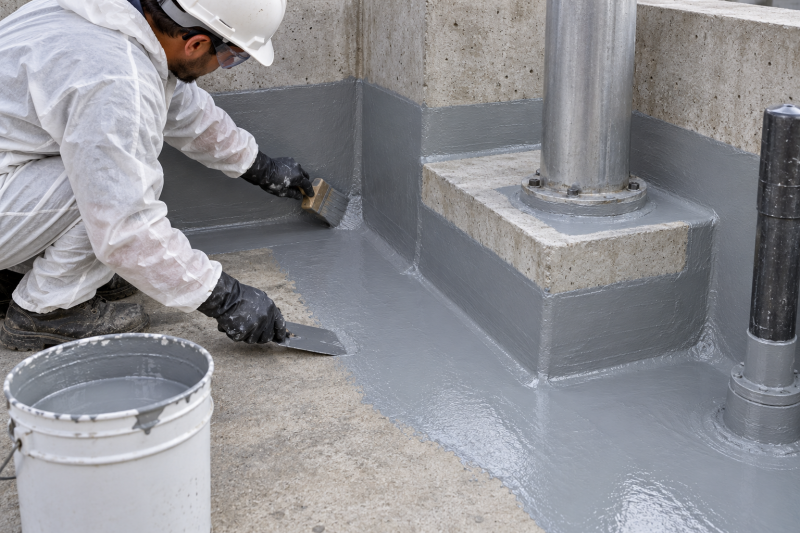
Irregular waterproofing details—including pipe penetrations, expansion joint transitions, parapet coping interfaces, drainage scuppers, and complex substrate junctions—often present access, geometry, or scale constraints that limit the use of spray-applied polyurea systems. Hand-applied polyurea coatings offer a viable alternative when:
- Spray equipment cannot be safely positioned or maneuvered;
- Detail areas are too small or geometrically intricate for consistent spray fan coverage;
- Project scope includes localized repairs or retrofit work without full-system re-coating;
- Site logistics restrict compressed-air or high-pressure delivery infrastructure.
Unlike traditional liquid-applied membranes, hand-applied polyurea formulations—particularly single-component variants—provide rapid setting, low VOC content, and strong adhesion across diverse substrates (concrete, metal, masonry, aged bitumen) without requiring primer in many cases. However, performance depends heavily on correct application methodology—not just product selection.
Key Technical Selection Criteria
Not all polyurea products are suitable for hand application. When evaluating options for irregular details, verify the following characteristics with current technical data sheets:
- Working time (pot life): Confirm the relevant technical requirement according to the selected system, project specification, and current technical documentation.
- Viscosity and sag resistance: Confirm the relevant technical requirement according to the selected system, project specification, and current technical documentation.
- Cure profile: Surface dry time under 30 minutes and tack-free time under 90 minutes support multi-layer builds and rapid return-to-service in phased projects.
- Adhesion performance: Confirm the relevant technical requirement according to the selected system, project specification, and current technical documentation.
Surface Preparation: Non-Negotiable for Detail Integrity
Irregular details concentrate stress and moisture pathways. Inadequate preparation is the leading cause of premature failure—even with high-performance coatings. Required steps include:
- Mechanical profiling: Request current product documentation and any project-required test evidence.
- Contaminant removal: Request current product documentation and any project-required test evidence.
- Moisture assessment: Confirm the relevant technical requirement according to the selected system, project specification, and current technical documentation.
Application Procedure for Complex Geometries
Manual application requires disciplined sequencing to ensure continuity, thickness control, and edge definition:
- Prime critical interfaces first: Apply a thin, controlled coat to substrate transitions (e.g., wall-to-slab, membrane-to-flashing) using a stiff-bristle brush. Avoid pooling at internal corners.
- Build layers incrementally: Confirm the relevant technical requirement according to the selected system, project specification, and current technical documentation.
- Reinforce high-stress zones: Embed non-woven polyester or alkali-resistant fiberglass mesh into the first wet coat at expansion joints, pipe boots, and movement joints. Ensure full encapsulation with a second coat.
- Tool edges precisely: Use angled scrapers or silicone-edged spreaders to define clean terminations at termination bars, drip edges, and flashing returns—avoid feathered edges that compromise long-term durability.
Procurement & Supply Considerations
For procurement teams and contractors managing multiple projects, confirm the following prior to order placement:
- Packaging format: Pails (e.g., 4 kg, 20 kg) designed for manual dispensing and minimal waste on small-detail scopes.
- Shelf life and storage conditions: Verify recommended ambient temperature range and maximum unopened shelf life per batch certificate.
- Project-specific commercial and supply requirements should be confirmed directly for the selected product.
- Sample availability: Request physical samples for applicator training and substrate compatibility validation before full-scale deployment.
For verified specifications and current packaging configurations, refer to the hand-applied polyurea coating product page.
Limits and Project Suitability Assessment
Hand-applied polyurea is not universally appropriate. Evaluate suitability against these constraints:
- Continuous immersion service: Not recommended unless specifically validated in TDS for submerged conditions.
- Confirm the relevant technical requirement according to the selected system, project specification, and current technical documentation.
- UV exposure: Unmodified aliphatic versions required for long-term color and gloss retention; aromatic variants may yellow and chalk.
- Confirm the relevant technical requirement according to the selected system, project specification, and current technical documentation.
Always consult the latest technical data sheet and project-specific system documentation before specification or application. Field conditions, substrate history, and interface materials significantly influence performance outcomes.

