

 English
 简体中文
 Español
 Deutsch
 Français
 Bahasa Indonesia
 Malaysia
 Português
 Русский язык
 بالعربية
 Kiswahili
 বাংলা
 Why PVC Roof Membranes Are Specified for Commercial Roof Renovation
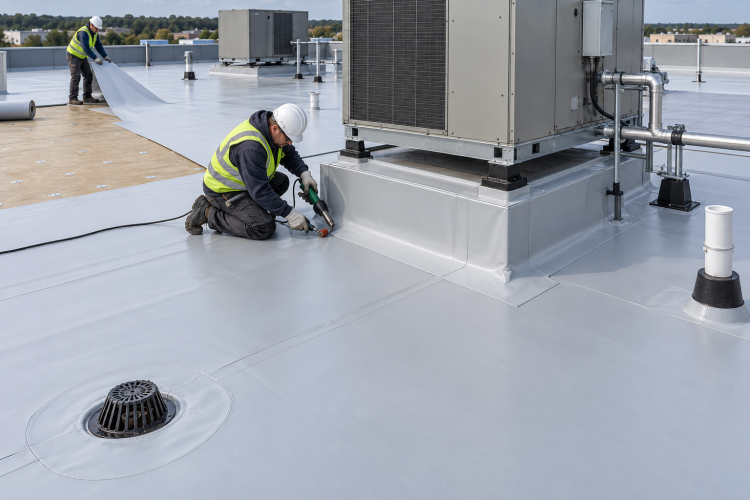
PVC (polyvinyl chloride) roof membranes are a common choice for low-slope commercial roof retrofits, particularly where existing roof assemblies remain structurally sound but require renewed waterproofing protection. Their thermoplastic nature enables hot-air welded seams with high tensile strength and consistent integrity—critical for long-term performance in large-area installations. Unlike some bituminous or single-ply alternatives, PVC membranes do not rely on adhesives or primers for seam formation, reducing variability from ambient conditions and substrate moisture.
Key Technical Advantages in Retrofit Contexts
- Weldable seams: Factory-welded or field-welded joints achieve seam strength comparable to the membrane body when executed per manufacturer instructions and verified via destructive or non-destructive testing protocols.
- Dimensional stability: Low coefficient of thermal expansion minimizes stress at penetrations, parapets, and terminations—important when overlaying aged substrates with variable movement behavior.
- Chemical resistance: Tolerant of rooftop HVAC condensate, cleaning agents, and incidental exposure to oils or greases commonly found on commercial rooftops.
- Recyclability potential: Post-demolition PVC membrane can be collected and processed for material recovery, supporting sustainability reporting goals on eligible projects.
Substrate Assessment and Preparation Prior to PVC Membrane Installation
Retrofit success begins with accurate evaluation of the existing roof assembly. PVC membranes may be installed as a fully adhered, mechanically attached, or ballasted system—but each method imposes distinct requirements on deck condition, fastener pull-out resistance, and surface flatness.
Critical Pre-Installation Checks
- Deck integrity: Confirm structural soundness of the underlying deck (concrete, metal, or wood). Delamination, rust-through, or rot compromises anchorage and load distribution.
- Moisture content: For adhered systems, substrate moisture must be within limits specified by the adhesive manufacturer—not solely the membrane TDS. Non-destructive moisture scanning is recommended before full-scale installation.
- Surface profile: Confirm the relevant technical requirement according to the selected system, project specification, and current technical documentation.
- Existing membrane compatibility: If overlaying an existing single-ply membrane (e.g., EPDM or TPO), verify chemical compatibility and adhesion performance through joint testing. Some PVC systems permit direct overlay only over clean, stable, and compatible substrates.
Application Methods and System Selection Criteria
Three primary attachment methods are used for PVC roof membranes in commercial renovation: fully adhered, mechanically attached, and ballasted. Selection depends on wind uplift requirements, deck type, building height, local code provisions, and long-term maintenance access.
Method Typical Use Cases Procurement & Supply Considerations Limited Applicability Notes Fully Adhered Low-rise buildings, decks with irregular surfaces, areas with high wind exposure where uplift resistance is critical Requires coordinated supply of membrane + compatible adhesive + primer; adhesive shelf life and storage conditions affect field usability Not suitable over damp or contaminated substrates without remediation; requires strict temperature/humidity control during application Mechanically Attached Steel or concrete decks, mid-rise structures, projects requiring rapid installation Fastener type, spacing, and washer configuration must align with wind uplift calculations per local design standards Penetrations increase risk of thermal bridging and localized condensation; insulation detailing at fastener zones is essential Ballasted Flat roofs with robust structural capacity, low-wind regions, temporary or phased occupancy scenarios Requires coordination of membrane roll weight, ballast type (river rock, pavers), and drainage clearance; ballast must be specified to prevent membrane abrasion Not appropriate where drainage is compromised or snow/ice accumulation is significant; reduces usable roof area for equipment placementCompliance and Specification Alignment
Request current product documentation and any project-required test evidence.
Additionally, all construction waterproof sheets—including PVC—fall under the scope of the upcoming mandatory standard GB 45320–2025 Safety and general technical specifications for construction waterproof sheets, effective 1 October 2025. While not yet in force, early alignment with its safety-related clauses (e.g., flame spread index, VOC emission limits, labeling requirements) supports future compliance readiness.
Procurement and Project Execution Considerations
For commercial renovation projects, procurement decisions extend beyond sheet thickness or color. Buyers should confirm:
- Request current product documentation and any project-required test evidence.
- If custom widths, reinforcement options (e.g., polyester scrim), or specialized formulations (e.g., enhanced root resistance) are available—and lead times for such variants;
- Project-specific commercial and supply requirements should be confirmed directly for the selected product.
- Confirm the relevant technical requirement according to the selected system, project specification, and current technical documentation.
- Logistics packaging: roll diameter, weight per roll, pallet configuration, and protection against UV exposure during site storage.
Contractors should verify that the selected PVC membrane system has been successfully applied in similar retrofit contexts—particularly where overlaying older built-up or modified bitumen roofs. Request case references aligned with building age, climate zone, and roof geometry.
Limitations and Risk Mitigation
PVC membranes perform best when installed according to current manufacturer technical data sheets and site-specific engineering details. Known limitations include:
- Confirm the relevant technical requirement according to the selected system, project specification, and current technical documentation.
- Potential plasticizer migration when in prolonged contact with certain asphaltic coatings or uncured resins;
- UV degradation of exposed edges or cut details if not protected with termination bars or compatible sealants;
- Request current product documentation and any project-required test evidence.
Project teams are advised to conduct mock-up panels prior to full installation and retain records of seam peel/adhesion tests per quality assurance protocols.
Next Steps for Technical Evaluation
For contractors and procurement buyers evaluating PVC membrane solutions for commercial roof renovation, the next step is to review system-specific technical documentation, confirm compliance with GB 12952–2011, and assess compatibility with your substrate and attachment strategy. Detailed product information—including formulation options, standard widths, and packaging configurations—is available for the PVC waterproof membrane.

