

 English
 简体中文
 Español
 Deutsch
 Français
 Bahasa Indonesia
 Malaysia
 Português
 Русский язык
 بالعربية
 Kiswahili
 বাংলা
Why Industrial Steel Protection Requires a Program-Based Approach
Unplanned downtime due to corrosion-related failure remains a top cost driver in manufacturing plants, power generation facilities, wastewater infrastructure, and material handling systems. Unlike one-off repairs, an effective industrial steel protection program integrates assessment, surface conditioning, product selection, application control, and documentation — all aligned with asset criticality, environmental exposure, and maintenance window constraints. This guide focuses on two complementary, low-VOC technologies widely adopted in maintenance workflows: for active rust stabilization and for barrier protection.
Key Selection Criteria for Industrial Steel Protection Systems
Selecting the right system begins with understanding the asset’s condition, exposure class, and operational requirements:
- Substrate condition: Heavily pitted or structurally compromised steel may require mechanical removal prior to chemical treatment; lightly rusted or sound mill-scale surfaces are typically suitable for rust converter application.
- Exposure environment: Indoor, sheltered, or intermittently wet conditions generally support water-based systems; continuous immersion or high-chloride splash zones may require supplemental topcoats or alternative chemistries — project-specific compatibility must be confirmed.
- Maintenance frequency & access: Rust converters enable faster turnaround by eliminating abrasive blasting in many cases; water-based anti-rust paints offer rapid recoatability and low odor, supporting work in occupied or confined areas.
- VOC and safety compliance: Water-based formulations reduce solvent handling risks and simplify ventilation requirements — verify local regulatory thresholds and facility EHS policies before specification.
Surface Preparation: The Foundation of Long-Term Performance
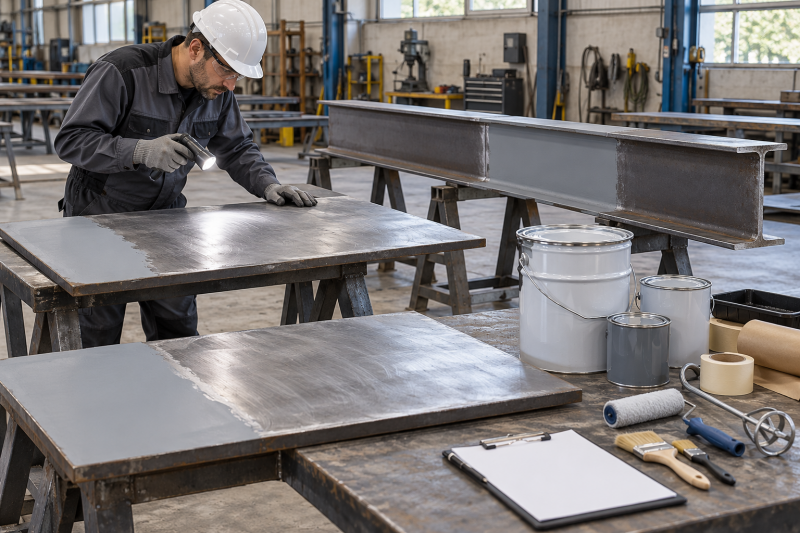
No protective system compensates for inadequate substrate preparation. For both rust converter and water-based anti-rust paint applications, the following steps are essential:
- Remove loose contaminants: Oil, grease, dust, salts, and flaking rust must be removed using solvent wipe, detergent wash, or low-pressure water rinse — avoid alkaline cleaners unless compatibility with the subsequent product is verified.
- Assess rust grade: Request current product documentation and any project-required test evidence.
- Dry thoroughly: Surface moisture content must be below manufacturer-specified limits — residual dampness can impair conversion chemistry or film adhesion.
Application Workflow: Integrating Rust Converter and Water-Based Anti-Rust Paint
A typical two-stage maintenance workflow includes:
Rust Converter Stage
Rust converter is applied directly to sound rust layers to stabilize active corrosion. Key considerations include:
- Apply uniformly using brush, roller, or low-pressure spray — avoid pooling or excessive film thickness.
- Confirm the relevant technical requirement according to the selected system, project specification, and current technical documentation.
- Verify conversion completion visually (uniform darkening) and by checking for absence of red rust bleed-through after light abrasion.
Water-Based Anti-Rust Paint Stage
This layer provides a protective barrier against moisture and atmospheric pollutants. Critical parameters include:
- Apply only after rust converter has fully cured and surface is clean, dry, and free of powder residue.
- Stir thoroughly before and during application; avoid thinning unless explicitly permitted by the technical data sheet.
- Confirm the relevant technical requirement according to the selected system, project specification, and current technical documentation.
- Confirm the relevant technical requirement according to the selected system, project specification, and current technical documentation.
Procurement & Supply Considerations for Distributors and Contractors
When sourcing for industrial maintenance programs, confirm the following with your supplier:
- Product availability in standard packaging sizes (e.g., 1 L, 5 L, 20 L containers) and bulk options.
- Batch traceability and lot-specific technical documentation (TDS, SDS) for quality assurance and audit readiness.
- Project-specific commercial and supply requirements should be confirmed directly for the selected product.
- Confirm the relevant technical requirement according to the selected system, project specification, and current technical documentation.
Limits and Verification Requirements
While rust converter and water-based anti-rust paint deliver value in many maintenance contexts, their suitability must be validated for each project. Neither product is intended for:
- Continuous immersion service without additional topcoat verification.
- Confirm the relevant technical requirement according to the selected system, project specification, and current technical documentation.
- Direct UV exposure without UV-stabilized topcoat (unless specified as UV-resistant in current TDS).
- Structurally compromised substrates requiring load-bearing repair.
Always consult the latest technical data sheets and conduct site-specific trials where performance-critical outcomes are required. Confirm VOC content, shelf life, storage conditions, and disposal guidelines prior to purchase.
Next Steps for Technical Confirmation
Project-specific commercial and supply requirements should be confirmed directly for the selected product.

