

 English
 简体中文
 Español
 Deutsch
 Français
 Bahasa Indonesia
 Malaysia
 Português
 Русский язык
 بالعربية
 Kiswahili
 বাংলা
 Introduction to TPO Roof Membrane Applications
TPO (thermoplastic polyolefin) roof membranes are widely specified for low-slope commercial roofing due to their weldable thermoplastic nature, UV resistance, and long-term dimensional stability. Unlike bituminous or PVC systems, TPO membranes rely on hot-air or wedge-welded seams for continuity and require strict adherence to substrate conditions, ambient parameters, and equipment calibration. This guide supports technical decision-making for roofing contractors, engineering consultants, and procurement teams responsible for specification, quality oversight, and supply coordination.
Key Standards Governing TPO Membranes in China
Two mandatory national standards define the baseline requirements for TPO roof membranes used in commercial construction projects:
- GB 27789–2011 – Thermoplastic polyolefin sheets for waterproofing: Specifies physical performance requirements including tensile strength, elongation at break, tear resistance, low-temperature flexibility, and heat aging resistance. It applies to factory-produced TPO sheets intended for exposed or protected roof applications.
- GB 45320–2025 – Safety and general technical specifications for construction waterproof sheets: A forthcoming mandatory standard effective from 1 October 2025. It introduces unified safety thresholds (e.g., flame spread, VOC emissions limits) and general technical benchmarks applicable across waterproof sheet categories, including TPO.
Request current product documentation and any project-required test evidence.
Substrate Preparation Requirements
A stable, clean, and dry substrate is fundamental to long-term TPO system performance. Acceptable substrates include concrete, structural steel decks with approved insulation boards (e.g., polyisocyanurate or mineral wool), and existing aged single-ply membranes meeting removal or overlay criteria.
Pre-installation checks must confirm:
- No standing water, frost, ice, or dew on the surface;
- Confirm the relevant technical requirement according to the selected system, project specification, and current technical documentation.
- Confirm the relevant technical requirement according to the selected system, project specification, and current technical documentation.
- Absence of oil, dust, curing compounds, or incompatible primers that compromise adhesion or weld integrity.
Where mechanical fastening is used, substrate pullout resistance must meet design load calculations — especially critical for wind-uplift zones defined in JGJ/T 253–2019 or project-specific wind tunnel reports.
Installation Methods and System Configurations
TPO membranes are typically installed using one of three primary methods, each with distinct procurement and QA implications:
Method Typical Use Case Key Procurement Considerations Mechanically Attached New construction over steel deck; moderate wind exposure Requires compatible fasteners, plates, and wind uplift-rated detail components. Fastener spacing must align with structural anchor schedule and local wind code. Ballasted Flat roofs with high dead load tolerance; low wind zones Confirm the relevant technical requirement according to the selected system, project specification, and current technical documentation. Adhered (Full or Partial) Recover over existing roof; sensitive interior environments Requires low-VOC, TPO-compatible adhesive meeting GB 45320–2025 emission limits. Adhesive coverage rate, open time, and cure window must be validated under site conditions.Seam Welding: Critical Parameters and Verification
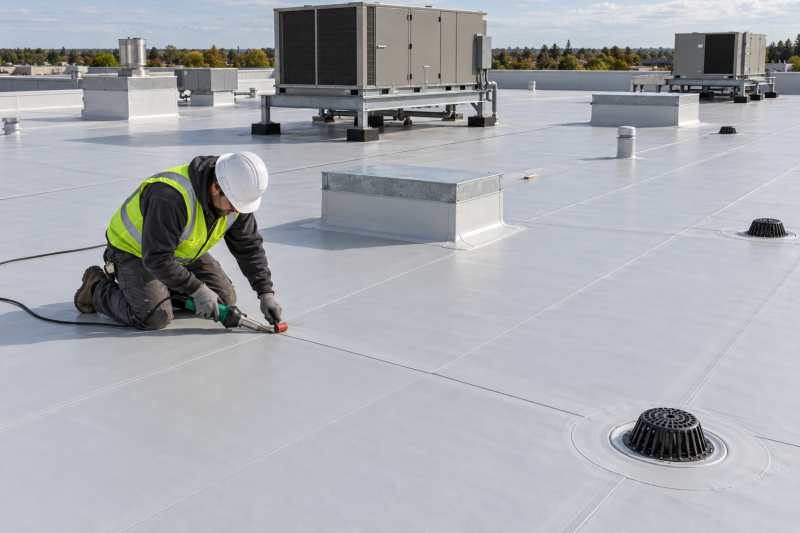
Hot-air or automatic wedge welding forms the primary waterproofing barrier. Seam integrity depends on calibrated equipment, trained operators, and real-time verification:
- Confirm the relevant technical requirement according to the selected system, project specification, and current technical documentation.
- Confirm the relevant technical requirement according to the selected system, project specification, and current technical documentation.
- Confirm the relevant technical requirement according to the selected system, project specification, and current technical documentation.
- Confirm the relevant technical requirement according to the selected system, project specification, and current technical documentation.
Confirm the relevant technical requirement according to the selected system, project specification, and current technical documentation.
Detailing and Penetration Flashing
Roof penetrations (pipes, curbs, scuppers, HVAC units) represent the highest risk zone for leakage. Best practices include:
- Use of factory-fabricated or field-welded TPO flashings — not cut-and-fit patches;
- Confirm the relevant technical requirement according to the selected system, project specification, and current technical documentation.
- Double-welded transitions at base-to-vertical interfaces;
- Integration with parapet coping or termination bars meeting GB 27789–2011 edge retention requirements.
Confirm the relevant technical requirement according to the selected system, project specification, and current technical documentation.
Procurement and Documentation Support
Project-specific commercial and supply requirements should be confirmed directly for the selected product.
- Request current product documentation and any project-required test evidence.
- Product data sheet (PDS) with full formulation disclosure (where non-proprietary);
- Request current product documentation and any project-required test evidence.
- Packaging details: roll dimensions, net weight, protective wrapping, and stacking instructions for site storage.
Project-specific commercial and supply requirements should be confirmed directly for the selected product.
Limitations and Risk Mitigation
TPO membranes are not suitable for all conditions. Key limitations include:
- Not recommended for direct burial or submerged applications;
- Performance degradation may occur when exposed to prolonged hydrocarbon contact (e.g., transformer fluids, asphaltic coatings);
- Confirm the relevant technical requirement according to the selected system, project specification, and current technical documentation.
- Long-term UV exposure without ballast or coating may accelerate surface chalking — verify expected service life against project design life.
Always consult the latest Technical Data Sheet (TDS) and Installation Manual before bid submission or mobilization. Site-specific conditions may necessitate deviation from generic guidance.
Next Steps for Project Teams
Contractors and procurement professionals are advised to:
- Confirm membrane thickness, reinforcement type, and surface finish against GB 27789–2011 classification (e.g., Type I, II, or III);
- Request current product documentation and any project-required test evidence.
- Request sample rolls and weld test protocols for pre-construction mock-up;
- Review compatibility of insulation, fasteners, adhesives, and flashings with the selected TPO membrane.
Project-specific commercial and supply requirements should be confirmed directly for the selected product.

