

 English
 简体中文
 Español
 Deutsch
 Français
 Bahasa Indonesia
 Malaysia
 Português
 Русский язык
 بالعربية
 Kiswahili
 বাংলা
 Introduction to Metal Roof Corrosion Challenges
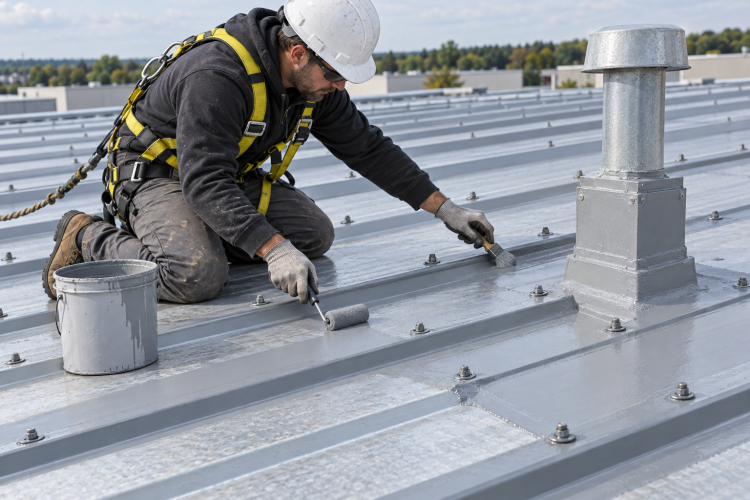
Metal roofing substrates — including galvanized steel, aluminum, and corrugated iron — offer structural durability but remain vulnerable to electrochemical degradation when exposed to moisture, chlorides, industrial pollutants, or thermal cycling. Rust formation compromises not only aesthetics but also structural integrity, fastener performance, and long-term watertightness. Unlike flat membrane systems, sloped metal roofs present unique challenges: runoff dynamics, thermal expansion stress, and limited substrate access during maintenance.
Why Combine Rust Conversion with Water-Based Anti-Rust Protection?
A two-stage approach is often preferred for aged or partially rusted metal roofs:
- Rust conversion chemically stabilizes existing rust (hydrated iron oxides) into an inert, adherent layer — typically a black or dark gray polymeric complex — that serves as a functional primer;
- Water-based anti-rust paint provides a breathable, non-yellowing topcoat that resists UV exposure, inhibits further oxidation, and maintains adhesion across temperature fluctuations.
This combination avoids aggressive abrasive blasting, reduces labor intensity, and supports sustainability goals by minimizing VOC emissions and hazardous waste generation.
Surface Preparation: Critical Pre-Application Steps
Successful application depends less on product selection than on consistent surface readiness. Key requirements include:
- Loose scale and flaking rust must be mechanically removed using wire brushing, scraping, or low-pressure (
- Oils, greases, and organic contaminants require cleaning with pH-neutral degreasers; solvent wiping is discouraged due to residue risk and VOC concerns;
- Chalky or powdery zinc oxide layers on weathered galvanized surfaces should be rinsed and lightly abraded to restore profile without damaging the underlying zinc;
- Moisture condition should be assessed against the selected system's current technical documentation and the project specification.
Application Sequence and Compatibility Checks
The standard sequence for field-applied systems is:
- Inspection and mechanical cleaning;
- Rust converter application (e.g., rust converter) — applied by brush, roller, or low-pressure spray;
- Drying and reaction period according to the selected product's current technical documentation and actual site conditions;
- Light sanding or scuffing of cured converter film if specified by TDS;
- Application of water-based anti-rust paint — usually in two coats, with intercoat drying per manufacturer instructions.
Do not apply over uncured converter films or incompatible primers. Confirm compatibility between the rust converter and subsequent water-based topcoat via joint testing or supplier documentation before full-scale deployment.
Environmental and Operational Limitations
These systems perform best under controlled conditions. Avoid application when:
- Environmental or substrate conditions are outside the selected system's documented application range;
- Humidity may impair application or initial cure under the selected system's documented conditions;
- Forecasted rain or condensation may affect the selected system before it reaches the required cure condition;
- Roof surfaces are subject to continuous immersion, ponding, or chemical splash exposure (e.g., acid fumes, caustic washdowns).
Long-term performance is reduced on surfaces with recurring mechanical abrasion (e.g., foot traffic, equipment movement) unless supplemented with a reinforced topcoat or protective overlay.
Procurement and Supply Considerations
For distributors and maintenance contractors, verify the following prior to order placement:
- Product formulation type (e.g., tannic acid– vs. phosphoric acid–based converter; acrylic vs. modified epoxy water-based anti-rust paint);
- Current packaging, shelf-life, and storage requirements for the selected product;
- Current order, delivery, and technical-documentation requirements for the intended procurement scope;
- Project-specific documentation and specification-alignment requirements.
Confirm whether samples, batch test reports, or formulation certifications (e.g., RoHS, REACH) are available upon request — these may impact compliance with facility-level procurement policies.
System Documentation and Project Suitability Assessment
Before specifying for a new project, cross-reference current technical documentation against site-specific parameters:
Parameter Typical Range Verification Required Dry-to-touch time 30–90 min Per TDS under actual site temperature/humidity Full cure time Confirm in current technical documentation Depends on film thickness and ventilation Coverage rate Confirm on a representative substrate Confirmed on representative substrate sample Adhesion (cross-cut) Project-specified acceptance criteria Tested after full cure on installed substrateAlways consult the latest version of the product’s Technical Data Sheet and confirm applicability to your specific metal type, existing corrosion stage, and service environment.
Conclusion and Next Steps
Metal roof waterproofing and corrosion control demand a systematic, documentation-led approach — especially when integrating rust conversion and water-based anti-rust technologies. Success hinges on accurate substrate assessment, adherence to environmental windows, and verification of compatibility and supply readiness. For product and project inquiries, provide the supplier with project specifications and substrate condition details to align documentation and technical requirements.

