

 English
 简体中文
 Español
 Deutsch
 Français
 Bahasa Indonesia
 Malaysia
 Português
 Русский язык
 بالعربية
 Kiswahili
 বাংলা

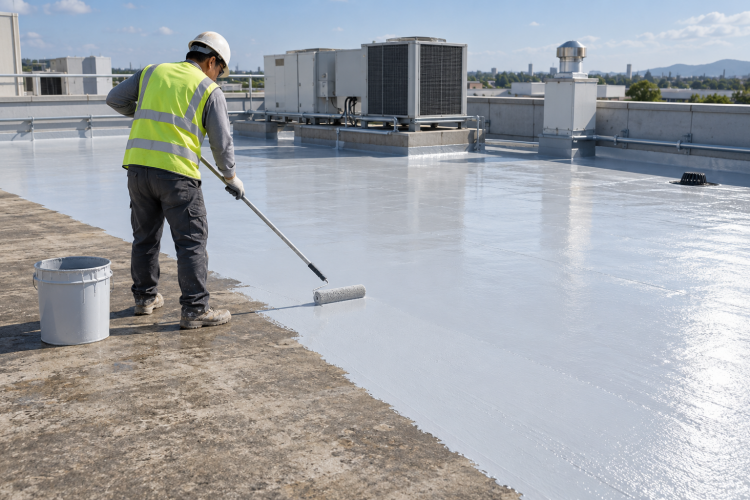 Why Industrial Roofs Require Reflective Thermal Insulation Coatings
Industrial facilities often feature large, low-slope or flat roofs with high thermal mass and limited ventilation. Under solar exposure, roof surfaces can experience substantial heat gain that affects indoor comfort and operational energy demand. Reflective thermal insulation coatings mitigate this by increasing solar reflectance and reducing surface temperature rise — a passive strategy aligned with building energy efficiency goals.
Understanding JG/T 235–2014 Requirements
JG/T 235–2014 is the applicable Chinese national standard governing reflective thermal insulation coatings for buildings. It defines product-level test requirements including:
- Solar reflectance ≥ 0.80 (measured per GB/T 25261)
- Thermal emittance ≥ 0.85 (measured per GB/T 26799)
- Water resistance (no blistering, peeling, or discoloration after 96 h immersion)
- Alkaline resistance (no blistering, peeling, or discoloration after 96 h in saturated Ca(OH)₂ solution)
- Freeze-thaw stability (no cracking, powdering, or separation after 10 cycles)
Note: JG/T 235–2014 sets test criteria for coated specimens under controlled laboratory conditions. It does not certify installed system performance, which depends on substrate condition, application quality, film thickness, and environmental exposure.
Substrate Preparation: A Critical Procurement & Execution Checkpoint
Coating adhesion and long-term durability are directly tied to substrate readiness. For industrial roofs, common substrates include aged bituminous membranes, EPDM, TPO, concrete, and metal decking. Each requires specific preparation:
- Bituminous membranes: Remove loose gravel, oil stains, and efflorescence; repair cracks and blisters per manufacturer guidelines; apply compatible primer if specified.
- EPDM/TPO: Clean with non-ionic detergent; verify no plasticizer migration or surface degradation; use only primers approved for the specific membrane type.
- Concrete: Confirm cure condition, surface cleanliness, and repair requirements against the project specification and current technical documentation.
- Metal decks: Remove rust, mill scale, and grease; apply corrosion-inhibiting primer prior to topcoat.
Confirm substrate moisture acceptance criteria using the selected system's current technical documentation. Ambient and substrate conditions, including temperature, humidity, and wind exposure, must align with the coating’s current technical documentation.
Application Protocol Considerations for Industrial Projects
Unlike residential applications, industrial roof coatings often serve dual functional roles: thermal management and protective waterproofing. Key procedural factors include:
- Film thickness control: Achieving minimum dry film thickness (DFT) as specified in the TDS is essential for meeting solar reflectance and emissivity targets. DFT is typically verified via wet film thickness (WFT) measurement and calibrated roller or spray settings.
- Number of coats: Most systems require two coats applied at recommended intervals. Recoat windows must be observed — exceeding maximum intercoat time may necessitate mechanical abrasion or repriming.
- Curing conditions: Confirm cure development and protection requirements in the selected system's current technical documentation. Early rain exposure or foot traffic before full cure risks surface damage and reduced reflectance.
Contractors should maintain batch traceability and document ambient conditions, substrate readings, and application logs for QA/QC purposes.
Procurement Verification Checklist
Buyers and specifiers should confirm the following before awarding supply contracts:
Item Verification Method Notes Compliance with JG/T 235–2014 Request current product documentation and any project-required test evidence Reports must be current and issued by CNAS-accredited labs Batch-specific TDS and SDS Confirm availability prior to order Required for safety, handling, and application planning Packaging and labeling Verify net volume per container, storage instructions, and shelf life Industrial projects may require bulk options — confirm availability separately Project-specific supply requirements Not confirmed by available evidence; direct supplier inquiry required Supplier confirmation needed before specificationLimitations and Risk Awareness
Reflective thermal insulation coatings are not standalone waterproofing solutions. They rely on an intact, watertight roof membrane beneath. If the underlying membrane is compromised, coating application may mask leaks and delay detection. Regular infrared thermography or moisture scans are recommended post-application to validate roof integrity.
Performance degrades over time due to soiling, chalking, and UV exposure. Maintenance cleaning protocols and recoat schedules should be defined during specification according to environmental exposure, project requirements, and current technical documentation.
Next Steps for Project Teams
To support your industrial roof heat control initiative, request the latest technical data sheet, test reports aligned with JG/T 235–2014, and substrate-specific application guidance. For project-specific technical inquiries — including compatibility with existing roof systems — contact the supplier directly with full project details. Learn more about the nano reflective thermal insulation coating and its application support resources.

