

 English
 简体中文
 Español
 Deutsch
 Français
 Bahasa Indonesia
 Malaysia
 Português
 Русский язык
 بالعربية
 Kiswahili
 বাংলা
 Why Exterior Wall Waterproofing Matters for Rendered Facades
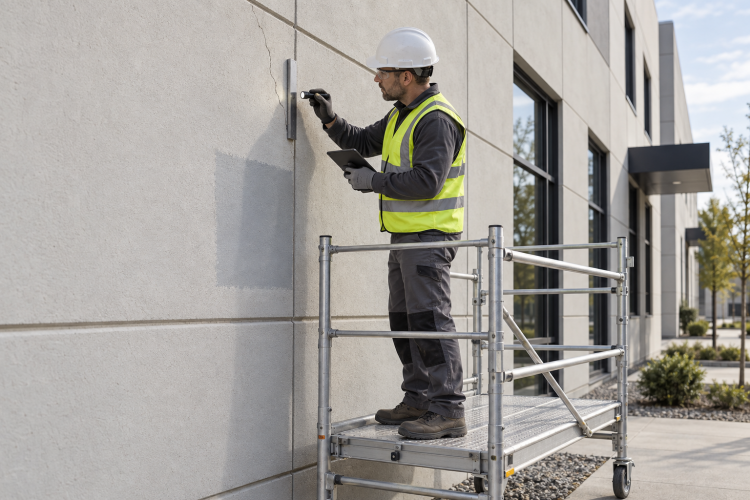
Rendered facades — typically composed of cement-lime or polymer-modified cementitious plasters — provide aesthetic finish and weather resistance but are inherently porous and vulnerable to water ingress. Without proper waterproofing, moisture penetration can lead to efflorescence, substrate deterioration, thermal bridging, freeze-thaw damage, and compromised building envelope integrity. For commercial and multi-residential projects, long-term durability depends on careful selection and execution of exterior wall waterproofing systems.
Key Technical Selection Criteria
When specifying an exterior wall waterproofing solution for rendered substrates, the following criteria must be evaluated against project-specific conditions:
- Substrate compatibility: Cementitious renders vary in porosity, alkalinity, and surface energy. Coating adhesion, alkali resistance, and vapor permeability must align with the render’s composition and age.
- UV and thermal stability: Vertical above-grade exposures demand resistance to UV degradation and thermal cycling. Acrylic-based systems generally offer better UV retention than bituminous or pure silicone alternatives.
- Vapor transmission: A breathable system is essential to avoid trapping moisture behind the render. High water-vapor permeability (often expressed as Sd-value < 0.5 m) helps prevent interstitial condensation.
- Crack-bridging capacity: Confirm the selected system's documented crack-bridging characteristics against the project specification, substrate condition, and detail requirements.
- Safety compliance: Review applicable product-safety requirements and project specifications for the selected exterior coating system.
Substrate Preparation: Non-Negotiable Steps
Successful waterproofing begins before the first coat is applied. Rendered surfaces must be:
- Cured and dry: Confirm render cure condition and moisture acceptance criteria against the project specification and the selected system's current technical documentation.
- Sound and stable: No loose particles, laitance, efflorescence, or existing coating residues. Mechanical abrasion or high-pressure water cleaning may be required; chemical cleaners must be fully rinsed and neutralized.
- Free of contaminants: Oil, grease, dust, form-release agents, or curing compounds compromise adhesion. Solvent wiping or alkaline degreasing may be necessary where contamination is suspected.
- Profiled appropriately: Smooth renders benefit from light abrasive profiling (e.g., 60–80 grit sanding) to enhance mechanical key. Overly aggressive profiling risks exposing aggregate or weakening the surface layer.
Application Protocol Considerations
For one-component acrylic waterproof coatings — commonly supplied ready-to-use and film-forming via coalescence — the following procedural points influence system performance:
- Temperature and humidity: Confirm suitable environmental and substrate conditions in the selected product's current technical documentation before application.
- Film thickness control: Dry film thickness (DFT) directly affects continuity, crack-bridging, and durability. Target DFT is usually 100–150 µm per coat. Achieving uniform thickness requires calibrated roller nap depth or airless spray settings — visual inspection alone is insufficient.
- Curing time between coats: Confirm curing conditions and recoat intervals in the selected product's current technical documentation and actual site conditions.
- Joint and detail treatment: Corners, penetrations, and movement joints require reinforcement with compatible non-woven fabric or mesh embedded into the wet coating. Lap widths and embedment depth must follow manufacturer guidance — generic recommendations do not substitute for product-specific instructions.
Procurement and Supply Considerations
Distributors and contractors should verify the following prior to order placement:
- Product documentation: Request current product technical and safety documentation, together with any project-required regulatory information. Use applicable product standards and project specifications as references; confirm product-specific evidence before approval.
- Packaging and shelf life: Confirm current shelf-life, storage, and delivery requirements for the selected product and order.
- Project-specific requirements: Confirm any tinting, formulation, compatibility, or technical-support requirements directly with the supplier for the intended application.
- Sample availability: Request physical samples for substrate adhesion trials and color verification before full-scale procurement. Field mock-ups should replicate expected environmental exposure and application tools.
Limits and Risk Mitigation
No exterior wall waterproofing system eliminates all moisture-related risks. Key limitations include:
- Acrylic coatings are not designed for hydrostatic pressure or submerged conditions — they are intended for rainwater shedding and wind-driven moisture resistance only.
- Performance degrades significantly if applied over improperly prepared, contaminated, or uncured render.
- Long-term UV resistance varies by formulation; pigmented versions generally outperform clear or white variants.
- Recoatability windows and overcoating compatibility with other systems (e.g., silicone topcoats or mineral paints) must be confirmed case-by-case — cross-contamination or incompatibility may cause delamination.
Next Steps for Project Teams
Before finalizing specifications or placing orders, confirm the following with your supplier:
- Current technical and safety documentation for the one-component acrylic waterproof coating, together with any project-required regulatory information;
- Recommended primer (if any) and compatibility with your specified render system;
- Minimum and maximum application temperature ranges for your project’s seasonal schedule;
- Availability of technical support for site supervision or adhesion testing protocols.
Always refer to the latest version of applicable standards and product documentation — parameters vary by formulation and project requirements.

