

 English
 简体中文
 Español
 Deutsch
 Français
 Bahasa Indonesia
 Malaysia
 Português
 Русский язык
 بالعربية
 Kiswahili
 বাংলা
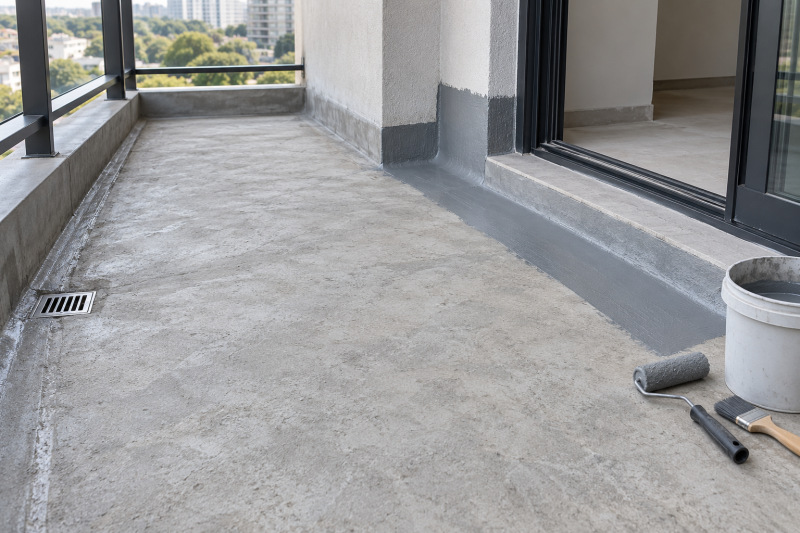 Why Balcony Waterproofing Must Be Addressed Before Final Finishes
Balconies present a high-risk interface between occupied space and external exposure. Unlike roofs or basements, balconies combine foot traffic, drainage constraints, thermal cycling, and direct contact with water from rain, irrigation, or cleaning. When tile, stone, or paver finishes are specified, the waterproofing layer must be fully functional *before* those finishes are laid — because post-installation remediation is costly, disruptive, and often structurally unfeasible. A failure at this interface typically manifests as interfacial delamination, efflorescence, or water migration into structural slabs or adjacent interior spaces.
Core Requirements for Pre-Finish Balcony Waterproofing Systems
A robust system must satisfy three interdependent criteria:
- Adhesion integrity: Strong bond to concrete, cementitious screeds, or repair mortars — without primer dependency where not justified by substrate condition;
- Flexibility and crack-bridging capacity: Ability to accommodate minor substrate movement and hairline cracking without loss of continuity;
- Compatibility with finish adhesives and setting beds: No chemical interference with thin-set mortars, polymer-modified adhesives, or grouts used for tile or stone installation.
These requirements are not generic — they depend on local climate exposure, structural movement tolerances, expected service life, and finish weight/thickness. Project specifications should reference applicable standards for verification, not just product datasheets.
Liquid-Applied Systems: Advantages and Limitations in Balcony Applications
Liquid-applied waterproofing — especially cold-applied, solvent-free formulations — offers distinct advantages for balcony applications:
- Seamless membrane formation over complex details (drain outlets, parapet upstands, pipe penetrations);
- No laps, seams, or heat-welding required;
- Good conformability to irregular substrates and control joints;
- Compatibility with common tile-setting systems when cured per manufacturer instructions.
However, limitations include sensitivity to ambient conditions during application (temperature, humidity, dew point), strict substrate moisture content thresholds, and dependence on proper film thickness and full cure prior to traffic or finish installation. These parameters vary by formulation and project requirements — always confirm current TDS and system documentation before specification.
One-Component Polyurethane Coating: Key Technical Considerations
One-component polyurethane waterproof coatings are widely used in balcony applications due to their moisture-curing chemistry, elasticity, and adhesion to damp (but not wet) concrete. Under GB/T 19250-2013, such products are classified and tested for tensile strength, elongation at break, impermeability, and low-temperature flexibility — all critical for balcony performance. Use applicable product standards and project specifications as references. Confirm the selected product's current documentation and any project-required test evidence before approval.
GB 45671-2025 (effective November 2025) introduces mandatory safety requirements for construction waterproof coatings, including VOC limits, heavy metal content, and labeling obligations. Procurement teams should ensure supplier documentation aligns with upcoming enforcement timelines.
For application under tile or stone, attention must be paid to:
- Cure time before troweling mortar beds — influenced by temperature, humidity, film thickness, and ventilation;
- Surface profile — some formulations require light abrasion or anti-dust treatment before adhesive application;
- Chemical resistance of the cured membrane to common thin-set components (e.g., acrylic dispersions, redispersible powders).
Always verify compatibility through joint testing or documented case references — not assumed from generic product class.
Substrate Preparation and Application Best Practices
Successful performance begins with substrate readiness:
- Confirm concrete cure condition, structural acceptance, and moisture criteria against the project specification and the selected system's current technical documentation;
- All laitance, curing compounds, oils, and loose particles must be removed — mechanical profiling (e.g., shot-blasting or grinding) is strongly recommended;
- Assess cracks and movement-related defects before coating, then select repair and reinforcement details according to the project design;
- Drain outlets, corners, and upstands require additional detailing layers — minimum 2–3 coats with embedded polyester fleece at critical junctions.
Application tools and environmental controls must follow the selected system's current technical documentation and the actual site conditions.
Procurement and Supply Considerations
When sourcing for commercial or infrastructure projects, procurement teams should request:
- Product-specific technical documentation and any test evidence required by the project specification;
- Supplier documentation addressing applicable product-safety and regulatory requirements;
- Full technical data sheet including shelf life, storage conditions, and recoat windows;
- Documentation of compatibility with the specified tile adhesives and grouts, as required by the project specification.
Confirm current commercial arrangements directly with the supplier for the required product and order volume.
Risk Mitigation and Verification Prior to Finish Installation
Before laying tile or stone, the following verifications are essential:
- Visual inspection for pinholes, bubbles, or missed areas;
- Wetting test or electronic leak detection (ELD) on full membrane area, especially around drains and edges;
- Any project-specified adhesion or continuity checks on representative sections;
- Confirmation that minimum cure time has elapsed under actual site conditions — not just calendar days.
Documenting these checks supports clear coordination before finishes are installed. Documentation of each verification step supports handover and long-term liability management.
Conclusion: A Systemic, Not Product-Centric, Approach
Balcony waterproofing before finishes is not solved by selecting a single product — it requires integrated evaluation of substrate, climate, finish system, and long-term maintenance access. One-component polyurethane coatings offer strong technical suitability, but only when applied within their defined performance envelope and verified against project-specific conditions. Architects, contractors, and procurement teams should jointly review technical documentation, conduct pre-application trials where feasible, and maintain traceable verification records throughout the process.
For technical inquiries regarding one-component polyurethane waterproof coating, including system compatibility, sample availability, or documentation support, contact YSROOM technical services with your project specifications.

