

 English
 简体中文
 Español
 Deutsch
 Français
 Bahasa Indonesia
 Malaysia
 Português
 Русский язык
 بالعربية
 Kiswahili
 বাংলা
 Why Basement Waterproofing Demands Rigorous Technical Oversight
Below-grade concrete foundations face persistent hydrostatic pressure, capillary rise, and soil-borne contaminants. Unlike above-grade applications, failure modes are often latent: dampness migration, alkali leaching, efflorescence, or long-term reinforcement corrosion — all of which compromise structural integrity and indoor environmental quality. For contractors and procurement teams, successful basement waterproofing hinges less on product selection alone and more on integrated system design, substrate readiness, and adherence to documented application protocols.
Key Substrate Requirements for Concrete Foundations
Concrete substrates must meet minimum performance thresholds before any waterproofing membrane is applied:
- Substrate readiness: Confirm structural acceptance criteria against the project specification, structural drawings, and documented substrate assessment.
- Maturity & moisture management: Confirm substrate maturity and moisture acceptance criteria using the project specification, applicable test methods, and the selected system's current technical documentation.
- Surface profile: Clean, sound, and free of laitance, oil, form release agents, or curing compounds. Shot blasting or mechanical scarification is recommended where surface tensile strength is uncertain.
- Crack management: Assess active cracks and movement-related defects before membrane application. Select repair and reinforcement details according to the project design and the selected system's technical documentation.
Selecting the Right Membrane System
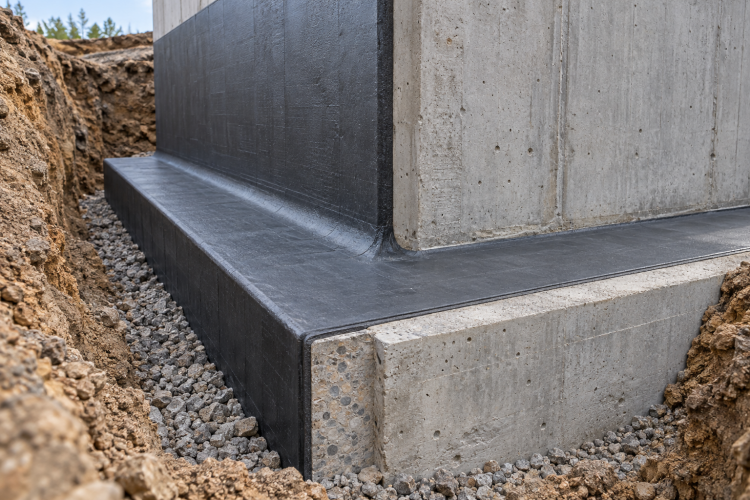
Liquid-applied waterproof membranes offer seamless coverage and adaptability to complex geometries — advantages critical for basement walls, footings, and cold joints. However, not all liquid membranes are suitable for continuous hydrostatic exposure. Key selection criteria include:
- Chemical exposure: Confirm compatibility with the expected groundwater and soil exposure using product-specific technical documentation and the project requirements.
- Adhesion: Review adhesion requirements and relevant test methods against the project specification and product-specific technical documentation.
- Flexibility: Select a system whose documented movement-accommodation characteristics suit the substrate and detail conditions.
- Safety compliance: All coatings applied indoors or in confined excavation zones must comply with GB 45671-2025, including VOC limits, flammability classification, and mandatory labeling of hazard information.
For procurement teams, the following documentation must be available and reviewed prior to order placement:
- Current technical documentation identifying applicable product standards and project-relevant application requirements.
- Current safety documentation and any project-required regulatory information for the selected system.
- Product-specific technical documentation and any test evidence required by the project specification.
- Supplier documentation addressing applicable product-safety and regulatory requirements.
Limitations and Risk Mitigation
No single membrane eliminates risk in compromised conditions. Avoid application where:
- Substrate has ongoing water infiltration or active leaks (requires dewatering or structural repair first).
- Backfill contains sharp-edged aggregate or ungraded fill without protective geotextile separation layer.
- Design lacks provision for drainage relief (e.g., perimeter drain tile, weep holes, or sump integration).
Contractors should retain application records — including ambient conditions logs, WFT/DFT measurements, and photo documentation of substrate prep — for QA/QC traceability and warranty validation.
Next Steps for Project Teams

