

 English
 简体中文
 Español
 Deutsch
 Français
 Bahasa Indonesia
 Malaysia
 Português
 Русский язык
 بالعربية
 Kiswahili
 বাংলা
Why Membrane Selection Matters in Commercial Roofing
For commercial low-slope roofing, the choice of single-ply waterproof membrane directly influences service life, maintenance frequency, energy performance, and long-term asset value. TPO (thermoplastic polyolefin) and PVC (polyvinyl chloride) are two widely specified thermoplastic membranes—but they differ significantly in chemistry, behavior under thermal cycling, seam integrity methods, and response to environmental exposure. This guide supports technical evaluation—not product endorsement—and focuses on objective criteria relevant to specification, tendering, and installation planning.
Core Material Differences: Chemistry and Structural Behavior
TPO and PVC are both thermoplastics, but their base polymers and formulation strategies lead to distinct physical responses:
- TPO is a blend of polypropylene or ethylene-propylene rubber with polyolefin-based fillers and stabilizers. It contains no chlorine and relies on proprietary polymer blending and UV absorbers for weather resistance.
- PVC is a chlorine-rich polymer stabilized with metal compounds (e.g., calcium-zinc or tin-based systems). Its inherent chemical structure provides high tensile strength, puncture resistance, and dimensional stability—but requires careful attention to plasticizer migration over time.
These differences affect how each membrane responds to temperature extremes, mechanical stress, and long-term aging—factors that influence seam durability, wind uplift resistance, and compatibility with rooftop equipment or ballast systems.
Performance Comparison Across Critical Criteria
The following table outlines key comparative parameters relevant to commercial project evaluation. Note that exact values vary by manufacturer, formulation, thickness (typically 1.2 mm to 2.0 mm), and reinforcement type (e.g., polyester scrim, fiberglass).
Criterion TPO Membrane PVC Membrane Typical Tensile Strength (MD/Cross) ≥ 200 / ≥ 150 N/cm (ASTM D638) ≥ 250 / ≥ 200 N/cm (ASTM D638) Elongation at Break ≥ 600% (ASTM D638) ≥ 300–400% (ASTM D638) Heat Resistance (Dimensional Stability) Moderate; may exhibit slight shrinkage above 70°C High; minimal shrinkage up to 80°C Low-Temperature Flexibility Good down to –25°C (ASTM D5091) Fair to good; depends on plasticizer system Seam Method Hot-air welding (requires calibrated equipment) Hot-air or hot-wedge welding; solvent welding possible for some formulations Chemical Resistance Limited resistance to hydrocarbons and certain solvents Broad resistance to acids, alkalis, oils, and greasesThermal Performance and Reflectivity
Both TPO and PVC are commonly available in white or light-colored formulations to meet cool roof standards (e.g., ENERGY STAR®, CRRC ratings). However, TPO’s formulation typically offers higher initial solar reflectance and better reflectance retention after 3 years of exposure—though real-world performance depends heavily on surface soiling, maintenance, and pigment stabilization. PVC maintains strong reflectivity but may experience more gradual degradation of reflectance due to surface oxidation if not properly formulated.
Wind Uplift and Fastening Considerations
Wind uplift resistance is governed primarily by attachment method (fully adhered, mechanically fastened, or ballasted), deck type, and edge details—not solely by membrane type. That said, PVC’s higher tensile modulus often allows for wider fastener spacing in mechanically attached systems, while TPO’s higher elongation may provide better accommodation of substrate movement in areas prone to thermal expansion/contraction. Both require compatible insulation boards and proper detailing at perimeters and penetrations.
Substrate Preparation and Application Requirements
Successful installation hinges on strict adherence to substrate specifications:
- Concrete decks: Must be clean, dry, and free of laitance or curing compounds. Primer use varies by manufacturer and membrane type.
- Steel decks: Require corrosion-resistant fasteners and compatible insulation. PVC may be preferred where galvanic corrosion risk exists near metallic components.
- Wood decks: Less common in commercial applications; require moisture content control and compatible adhesives.
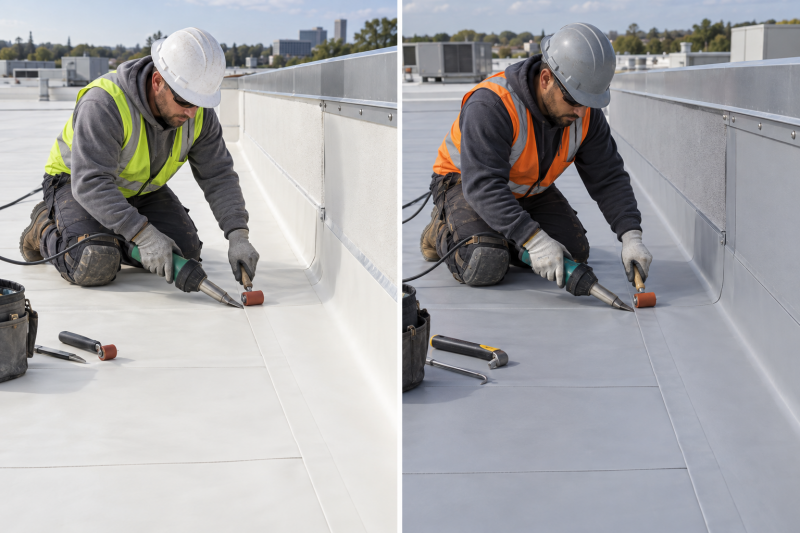
Hot-air welding parameters—including air temperature, nozzle speed, and pressure—must be validated for each membrane batch and ambient condition. Weld strength testing (peel and shear) should be conducted per ASTM D6382 during commissioning. Field quality assurance is especially critical for TPO, as improper welds may show no visible defect but fail under cyclic loading.
Procurement and Supply Considerations for Buyers
When sourcing TPO or PVC membranes for commercial projects, procurement teams should verify the following before tender submission or purchase order issuance:
- Thickness and reinforcement: Confirm nominal thickness and scrim type match specification requirements.
- Roll dimensions and packaging: Standard roll widths range from 1.05 m to 2.05 m; lengths typically 15–30 m. Packaging must protect against UV exposure and mechanical damage during transit and site storage.
- Documentation support: Request full test reports (tensile, elongation, heat resistance, low-temp flexibility), third-party certification summaries (where applicable), and installation guidelines aligned with local building codes.
- OEM or custom formulation capability: If project-specific requirements exist (e.g., enhanced fire rating, VOC compliance, or color matching), confirm supplier capacity to support such requests.
Note: Minimum order quantities, lead times, and sample availability depend on production scheduling and regional logistics. These parameters require direct confirmation with the supplier prior to procurement planning.
When to Consider TPO vs PVC: Scenario-Based Guidance
No single membrane is universally optimal. Selection should be driven by project-specific constraints:
- TPO may be prioritized when: High initial solar reflectance and cost-efficiency are primary objectives; the roof is fully exposed to intense UV and thermal cycling; and the project is located in moderate to cold climates with limited chemical exposure.
- PVC may be prioritized when: Chemical resistance (e.g., food processing, laboratories, HVAC condensate zones) or long-term dimensional stability under sustained heat is required; mechanical fastening is the preferred attachment method; or existing roof systems contain PVC components requiring compatibility.
Hybrid or transitional scenarios—such as retrofit over aged EPDM or built-up roofing—require detailed compatibility assessment, including adhesion testing and interface priming protocols.
Limitations and Risk Mitigation
Both TPO and PVC have known limitations that impact long-term performance:
- TPO: Potential for surfactant leaching in early service life; sensitivity to certain asphaltic coatings or incompatible sealants; reduced performance if installed below minimum recommended ambient temperatures.
- PVC: Risk of plasticizer migration in high-heat environments or under prolonged compression (e.g., beneath heavy ballast); potential for discoloration or chalking if UV stabilizers degrade prematurely.
Mitigation begins with rigorous supplier qualification—including review of field performance history, warranty terms, and technical support responsiveness—not just product data sheets.
Next Steps for Project Teams

