

 English
 简体中文
 Español
 Deutsch
 Français
 Bahasa Indonesia
 Malaysia
 Português
 Русский язык
 بالعربية
 Kiswahili
 বাংলা
 Why Complex Roof Details Demand Specialized Waterproofing
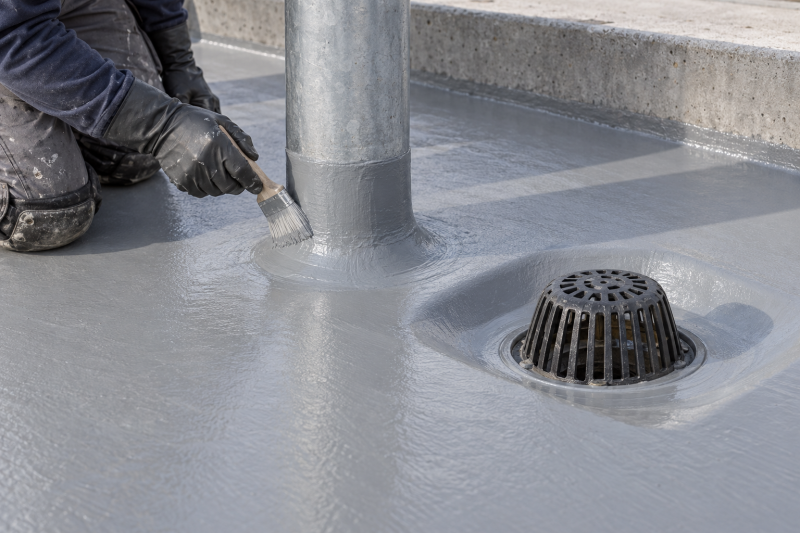
While large-field waterproofing is often straightforward, roof details are frequent sources of leakage in commercial low-slope roofs. Penetrations—including mechanical units, pipes, vents, and conduit—introduce thermal movement, differential settlement, and three-dimensional geometry that rigid or sheet-based systems may not accommodate reliably. Liquid-applied membranes provide excellent conformability and continuous coverage across irregular surfaces—but only when applied with disciplined technique and attention to detail.
Key Detail Types and Their Waterproofing Challenges
Pipe Boots and Conduit Penetrations
Small-diameter penetrations require precise edge treatment to manage stress at the interface between pipe and membrane. Recommended approaches include:
- Maintaining a consistent vertical upstand height above finished roof level;
- Embedding compatible fabric reinforcement into the first wet coat at the base;
- Applying multiple full coats over the entire detail area, with staggered fabric laps where used;
- Allowing for thermal expansion—avoid rigid flashing collars directly bonded over the membrane unless verified for movement accommodation.
HVAC Curbs and Mechanical Units
Large curbs impose dynamic loading and long-term compression. The transition from curb side to roof deck must be fully sealed—not just at the base, but also along vertical faces and corners. Key steps include:
- Priming all concrete, metal, or masonry surfaces per manufacturer instructions;
- Forming a reinforced fillet at the curb-to-deck junction to eliminate sharp angles;
- Extending the membrane up the curb face and terminating with a compatible method;
- Sequencing membrane application before curb installation where feasible—or confirming compatibility with post-install anchoring methods.
Internal Drains, Scuppers, and Overflow Outlets
Drain assemblies involve multiple interfaces—clamping rings, strainer baskets, and collar welds—where incomplete coverage or poor adhesion can lead to leaks. Best practice includes:
- Cleaning and priming all metal surfaces—including interior bowl surfaces—before membrane application;
- Applying membrane in layers: first coat to bond the drain body, second coat with embedded fabric extending beyond the clamping ring footprint;
- Verifying final membrane thickness meets specified requirements after full cure;
- Avoiding excessive buildup inside the drain throat that could impede flow or trap debris.
Substrate Preparation: Non-Negotiable for Detail Integrity
Detail areas are especially sensitive to substrate condition. Even minor contamination at a pipe base or curb corner can compromise adhesion. Required preparation includes:
- Mechanical abrasion of metal, concrete, and masonry surfaces to remove loose material and ensure sound bonding;
- Removing curing compounds, form-release agents, and efflorescence from concrete substrates;
- Drying substrates prior to priming—verify moisture levels align with product recommendations;
- Sealing wider cracks with flexible, compatible repair materials before membrane application.
Application Sequencing and Layering Protocol
Details require strict sequencing to ensure complete coverage and avoid air entrapment or uncured zones. A recommended workflow:
- Apply primer to all substrates—allow full dry-to-touch time as specified;
- Apply first membrane coat to horizontal surfaces and vertical bases—embed fabric reinforcement while wet;
- Allow first coat to reach green strength (timing depends on ambient conditions);
- Apply second coat, extending fully over first coat and fabric—including vertical upstands and radiused corners;
- Inspect for pinholes, thin spots, and missed areas using visual and tactile verification;
- Allow full cure before traffic or overburden placement (cure time varies by formulation and environment).
Procurement and Supply Considerations
When specifying liquid waterproof membranes for complex detailing, procurement teams should confirm the following with suppliers:
- Availability of technical data sheets (TDS), safety data sheets (SDS), and application guidance for detail work;
- Compatibility documentation for primers, reinforcements, and termination accessories;
- Recommended application temperature range, recoat windows, and pot life under expected site conditions;
- Support for project-specific documentation packages—e.g., QA checklists or compliance summaries.
For projects requiring coordinated delivery timelines or custom packaging, early engagement with the supplier helps align logistics and expectations.
Limitations and Risk Mitigation
Liquid membranes offer strong performance across complex geometries—but their suitability depends on proper specification and execution. Key considerations include:
- Not all formulations are validated for submerged or continuous ponding exposure;
- Performance relies heavily on installer training—consider third-party applicator certification where project risk warrants;
- Low-temperature application requires verification of viscosity stability and film formation capability;
- UV exposure during cure should be assessed: some products benefit from temporary shading or protective topcoats if UV resistance is limited.
Contractors are advised to conduct mock-up panels at representative details prior to full-scale application to validate workmanship, material behavior, and compatibility with adjacent systems.
Next Steps for Project Teams
If your upcoming project involves extensive roof penetrations, curbs, or drainage complexity, request the full liquid waterproof membrane technical package—including detail drawings, primer compatibility guidance, and recommended reinforcement specifications. Confirm availability of project-specific support, sample kits for mock-up validation, and alignment of delivery schedules.

