

 English
 简体中文
 Español
 Deutsch
 Français
 Bahasa Indonesia
 Malaysia
 Português
 Русский язык
 بالعربية
 Kiswahili
 বাংলা

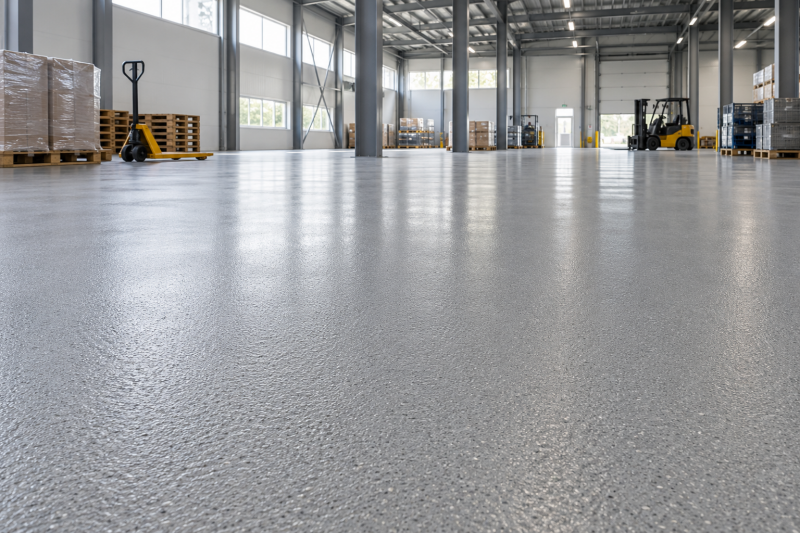 Why a Three-Layer Epoxy System Is Standard for Industrial Buildings
Industrial environments — including manufacturing plants, warehouses, food processing units, and logistics hubs — demand flooring systems that resist heavy traffic, mechanical abrasion, chemical spills, and thermal cycling. A single-coat epoxy solution rarely meets these combined requirements. Instead, a coordinated three-layer system — consisting of an epoxy floor primer, epoxy floor middle coat, and epoxy floor top coat — delivers layered functionality: strong adhesion, structural build-up, and surface protection.
Layer-by-Layer Functional Roles
Each layer serves a distinct technical purpose and must be chemically compatible and properly sequenced:
- Epoxy floor primer: Penetrates porous concrete substrates, seals capillaries, enhances interfacial bond strength, and provides a uniform base for subsequent layers. Critical for preventing delamination under dynamic loads.
- Epoxy floor middle coat: Builds film thickness, bridges minor substrate imperfections, improves impact resistance, and contributes to overall chemical barrier integrity. Often formulated with fillers or quartz aggregates for added hardness and slip resistance.
- Epoxy floor top coat: Provides the final wear surface — delivering abrasion resistance, gloss control, cleanability, and optional functional properties such as UV stability (if aliphatic), anti-static behavior, or antimicrobial performance. Acts as the primary interface with foot and vehicle traffic.
Substrate Preparation: The Non-Negotiable First Step
No epoxy system performs as intended without proper substrate evaluation and preparation. Industrial concrete slabs should be assessed for key physical and moisture-related properties before any coating is applied. While exact thresholds may vary by product formulation and regional standards, widely accepted benchmarks include:
- Compressive strength — generally ≥ 25 MPa for structural integrity;
- Moisture vapor emission rate (MVER) — typically ≤ 4.5 kg/100 m²/24 h (per ASTM F1869);
- Relative humidity at depth — often ≤ 75% at 4 cm (per ASTM F2170);
- Surface profile — CSP 2–3 (concrete surface profile), achieved via mechanical grinding or shot blasting;
- Cleanliness — free of curing compounds, oils, grease, laitance, or previous incompatible coatings.
Failure to verify and correct substrate conditions is the leading cause of premature epoxy failure — including blistering, edge lifting, and loss of adhesion.
Application Sequence & Curing Considerations
Application must follow strict time windows and environmental controls — but precise parameters depend on ambient temperature, humidity, ventilation, and specific product chemistry. General guidance includes:
- Primer should be applied soon after profiling — ideally within 24 hours — to avoid recontamination.
- Inter-coat recoat windows are formulation-dependent; typical minimums range from 8–24 hours, while maximum windows often fall between 48–72 hours. Beyond this, light abrasion (e.g., scuff-sanding) is usually required to ensure interlayer adhesion.
- Cure-to-traffic intervals vary significantly: light foot traffic may be permitted after 24–48 hours; full vehicular loading often requires 5–7 days at standard conditions (20°C, 50% RH). Low temperatures (85% RH) will extend these timelines and may require adjusted mixing ratios or specialized hardeners — confirm compatibility with your supplier.
Procurement & Specification Guidance
When sourcing materials for industrial epoxy flooring projects, specify by functional performance criteria rather than generic grade names. Key procurement checkpoints include:
- System compatibility: Confirm that the epoxy floor primer, epoxy floor middle coat, and epoxy floor top coat are supplied as a matched system — not mixed from different product families — to ensure predictable interlayer adhesion and long-term durability.
- VOC compliance: Verify VOC content aligns with applicable regional regulatory limits (e.g., ≤ 350 g/L in many EU and U.S. jurisdictions); request current test reports if required for LEED, BREEAM, or other sustainability documentation.
- Packaging & shelf life: Check batch-specific expiration dates and storage instructions (e.g., ‘store below 30°C, protect from freezing’). Bulk packaging options may be available for large-scale projects.
- Documentation support: Request technical data sheets (TDS), safety data sheets (SDS), and application guides in English prior to order placement.
When to Consider System Variants
While the three-layer system covers most industrial applications, certain conditions warrant evaluation of alternatives:
- Heavy-duty vehicular zones: Add a quartz or aluminum oxide broadcast into the wet middle coat for enhanced abrasion resistance.
- Wet-process areas: Specify a seamless, coved base detail and consider a polyaspartic or methyl methacrylate (MMA) top coat for faster return-to-service.
- Static-sensitive environments: Integrate conductive copper strips and use an antistatic middle coat + top coat system — verify surface resistance per ANSI/ESD S20.20.
- High-UV exposure: Avoid standard bisphenol-A epoxies for exterior or skylit interior zones; opt for UV-stable aliphatic polyurethane or polyaspartic top coats.
Limitations & Risk Mitigation
Even well-applied epoxy systems have operational boundaries:
- Not suitable for substrates with active cracking or uncontrolled moisture migration — address structural issues first.
- Performance degrades under sustained contact with strong oxidizers (e.g., chlorine-based cleaners), hot concentrated acids, or ketones — define cleaning protocols early.
- Thermal shock from rapid temperature swings may induce microcracking in thick-film systems.
- Recoatability depends on surface profiling — aged epoxy surfaces require thorough abrasion and solvent wipe before reapplication.
Always conduct a site-specific feasibility review — including substrate testing, environmental logging, and traffic analysis — before finalizing specifications

