

 English
 简体中文
 Español
 Deutsch
 Français
 Bahasa Indonesia
 Malaysia
 Português
 Русский язык
 بالعربية
 Kiswahili
 বাংলা
 Why a System Approach Matters in Corrosion Control
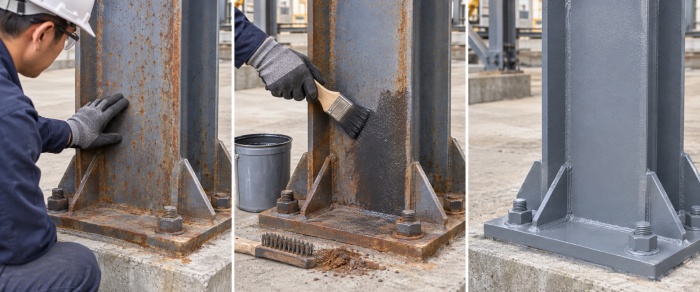
Corrosion is not a static condition but an active electrochemical process influenced by substrate condition, environmental exposure, mechanical stress, and coating integrity. Relying solely on barrier protection (e.g., paint) over unsound rust or using conversion chemistry without subsequent encapsulation leads to premature failure—especially in high-humidity, saline, or cyclic thermal environments. A robust corrosion-control system integrates three functional layers: surface stabilization, barrier formation, and long-term durability reinforcement. Rust converter and water-based anti-rust coating each serve distinct, non-interchangeable roles in this sequence.
Rust Converter: Function, Limits, and Role in the System
A rust converter is a reactive chemical formulation—typically tannic acid- or phosphoric acid-based—that transforms loose, hydrated iron oxide (FeOOH, Fe₂O₃·nH₂O) into a stable, adherent, insoluble complex (e.g., iron tannate or iron phosphate). Its primary purpose is surface stabilization, not rust removal or long-term protection.
- What it does well: Converts active rust into an inert, black-to-purple film; improves adhesion of subsequent coatings; reduces surface porosity; minimizes flash rust during multi-step applications.
- What it does not do: Remove mill scale, heavy pitting, or non-rust contaminants (oil, grease, salts); provide UV resistance or abrasion resistance; replace mechanical preparation on heavily corroded or structurally compromised substrates.
For industrial maintenance buyers and contractors, rust converter is most effective when applied to surfaces with light-to-moderate rust (ISO 8501-1 St2–St3), after thorough cleaning and drying. It is not recommended for bare, uncorroded steel or galvanized surfaces unless explicitly validated for such use.
Water-Based Anti-Rust Coating: Barrier Function and Compatibility Requirements
Water-based anti-rust coatings are formulated to deliver protective film formation with lower VOC content and simplified handling versus solvent-based alternatives. Their performance hinges on proper film build, crosslink density, pigment dispersion, and compatibility with underlying layers.
When used downstream of rust converter, compatibility becomes critical:
- The rust converter layer must be fully cured and neutralized before topcoating—typically requiring 24–72 hours depending on ambient temperature and humidity.
- Water-based coatings may lift or blister if applied over incompletely reacted converter films or residual acid.
- Adhesion testing (e.g., ASTM D3359 cross-hatch) is recommended on representative substrate samples before full-scale application.
Water-based anti-rust coatings are suitable for interior structural steel, secondary framing, equipment housings, and maintenance touch-ups where ventilation supports adequate drying. They are generally not rated for immersion service, continuous outdoor UV exposure without UV-stabilized formulations, or high-abrasion zones without supplemental topcoats.
Integration Sequence: From Assessment to Application
A technically sound corrosion-control system follows this staged workflow:
- Assessment: Determine rust grade (per ISO 8501-1), substrate type (carbon steel, weathering steel, etc.), environmental class (C2–C4 per ISO 12944), and service life expectations.
- Preparation: Remove loose rust, scale, and contaminants via wire brushing, abrasive blasting (Sa 2½ preferred), or high-pressure water cleaning. Verify surface dryness and salt contamination levels (e.g., soluble chloride test).
- Conversion: Apply rust converter uniformly; allow full reaction time (per product instructions); verify visual transformation (uniform darkening) and absence of tackiness.
- Barrier Application: Apply water-based anti-rust coating at specified wet film thickness (WFT); ensure intercoat interval compliance; avoid application below minimum recommended temperature (often ≥10°C).
- Verification: Conduct visual inspection, dry-film thickness (DFT) measurement, and adhesion spot checks post-cure.
Procurement and Supply Considerations for B2B Buyers
For distributors and contractors procuring these materials, key technical and logistical factors include:
- Batch consistency: Request lot-specific technical data sheets (TDS) and confirm shelf life under storage conditions (typically 12–24 months unopened, cool/dry).
- Packaging formats: Confirm available container sizes (e.g., 1 L, 5 L, 20 L) and labeling compliance (GHS hazard pictograms, safety phrases).
- OEM and documentation support: Inquire whether technical support is available for project-specific formulation adjustments, compatibility testing reports, or bilingual SDS/TDS packages.
- Lead-time and MOQ: Clarify minimum order quantities and standard lead times for regional distribution—especially for blended or custom-tinted batches.
Limitations and Risk Mitigation
No corrosion-control system eliminates risk entirely. Key constraints include:
- Rust converter efficacy declines significantly on rust layers thicker than 100 µm or in presence of chlorides/sulfates.
- Water-based anti-rust coatings require longer drying times in high-humidity environments, increasing vulnerability to dust pickup or moisture entrapment.
- Neither component replaces structural repair—pitted or thinned sections must be addressed mechanically prior to chemical treatment.
- Long-term performance validation (e.g., salt-spray testing per ASTM B117 or ISO 9227) depends on full system execution—not individual product specs.
Conclusion: Coordination Over Isolation
Treating rust converter and water-based anti-rust coating as isolated products invites performance gaps. Their value emerges only when integrated into a documented, sequenced, and verified corrosion-control system—one aligned with ISO 12944 classification, substrate condition, and end-use environment. For industrial maintenance buyers and contractors, success starts with specifying compatible chemistries, validating application parameters on-site, and confirming documentation and supply readiness before mobilization. Technical inquiry regarding formulation compatibility, sample availability, or project-specific documentation support is recommended prior to procurement.
Selecting the right acrylic waterproof coating for exposed applications—such as flat roofs, balconies, terraces, and parapet walls—requires more than surface-level specification review. This acrylic waterproof coating buyer guide outlines key technical, application, and supply factors that procurement teams, roofing contractors, and wholesale buyers must assess before committing to a product. It focuses on real-world performance drivers—not marketing claims—and highlights documentation, compatibility, and verification steps critical for B2B decision-making.

