

 English
 简体中文
 Español
 Deutsch
 Français
 Bahasa Indonesia
 Malaysia
 Português
 Русский язык
 بالعربية
 Kiswahili
 বাংলা
 Why Membrane Selection Matters in Commercial Projects
Waterproofing failure in commercial buildings carries high consequence: structural degradation, tenant disruption, warranty claims, and reputational risk. Unlike residential retrofits, commercial projects demand systems that align with tight schedules, complex geometries, strict tolerances, and long service life expectations (typically 15–25 years). Liquid-applied and sheet membrane systems each address these demands differently—neither is universally superior. The optimal choice depends on substrate type, detailing complexity, labor availability, quality control capacity, and post-installation access requirements.
Core Differences: Application Method & System Integration
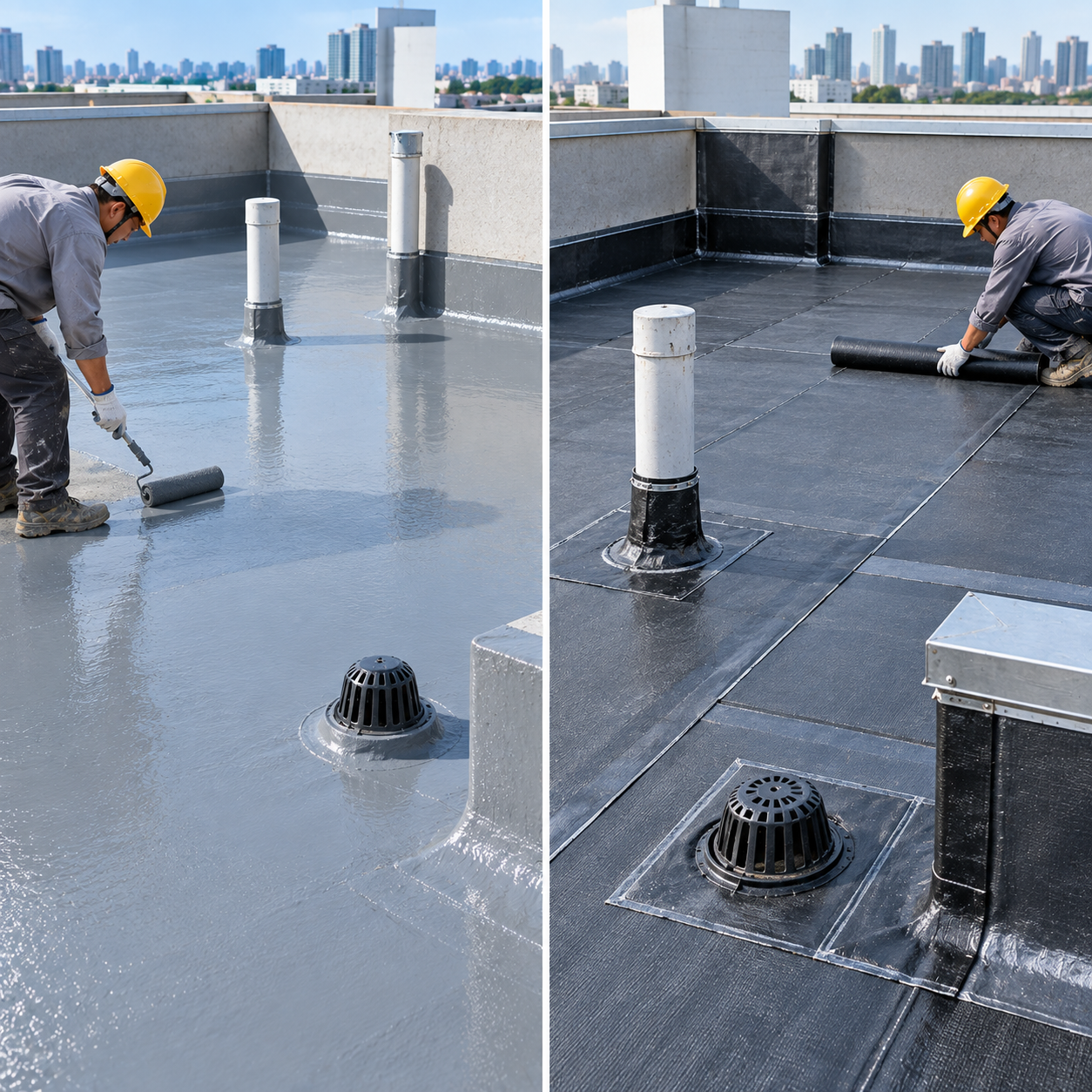
Liquid waterproofing membrane is applied in-situ as a fluid coating—typically via roller, trowel, or spray—and cures to form a continuous, seamless film. It bonds directly to the substrate, conforming precisely to irregularities, penetrations, and transitions. Common chemistries include polyurethane, acrylic, and bituminous emulsions; performance parameters (e.g., elongation, tensile strength, UV resistance) vary significantly by formulation.
Sheet membrane (e.g., TPO, PVC, EPDM, or modified bitumen) arrives pre-fabricated in rolls or sheets. Installation requires mechanical fastening, heat welding, adhesive bonding, or torch application. Seam integrity, edge termination, and flashing detail execution are critical success factors—each seam represents a potential discontinuity in the barrier.
Installation Considerations for Contractors
Contractors must assess not only speed but also controllability under real-site conditions:
- Weather sensitivity: Most liquid systems require specific temperature and humidity windows during application and curing. Rain exposure before full cure may compromise film formation. Sheet membranes are less sensitive to ambient moisture during installation—but dew point control remains essential for adhesive or welding operations.
- Labor skill dependency: Liquid application demands consistent film thickness, proper mixing (for two-component systems), and timely re-coating intervals. Sheet membranes rely heavily on trained crews for seam welding, hot-air gun operation, or torch safety compliance.
- Substrate preparation: Both systems require clean, sound, and dry substrates—but liquid membranes often tolerate minor surface imperfections better due to their self-leveling nature. Sheet membranes require flatter, smoother surfaces to avoid bridging voids or inducing stress at wrinkles.
Performance & Durability in Real-World Conditions
Durability isn’t solely about material thickness—it’s about continuity, adhesion, movement accommodation, and resistance to localized damage:
Factor Liquid Waterproofing Membrane Sheet Membrane (e.g., TPO) Seam integrity Seamless—no intentional joints; transitions handled via built-up detailing Dependent on installer skill and environmental controls during welding/adhesion Crack bridging Generally higher elongation allows limited accommodation of non-structural substrate movement Depends on sheet flexibility and anchorage method; rigidly adhered systems offer less bridging Puncture resistance Lower initial resistance; relies on protection layer or topping for traffic exposure Higher inherent puncture resistance, especially with reinforced scrim or thicker gauges Repairability Localized repairs possible without full system removal; compatible liquid patching typically sufficient Requires precise cutting, cleaning, and re-welding or adhesive patching; mismatched materials can cause delaminationProcurement & Supply Chain Factors
Project buyers and procurement managers should confirm key supply parameters early:
- Packaging & storage: Liquid membranes are typically supplied in pails or drums requiring controlled storage (temperature, freeze-thaw stability, shelf life). Sheet membranes arrive in rolls—space-efficient but sensitive to kinking, UV exposure, and stacking height.
- MOQ & lead time: Minimum order quantities and production lead times vary by formulation and regional distribution. Confirmation is required prior to tender submission.
- OEM & documentation support: For projects requiring third-party certification references or custom formulation alignment, suppliers should be engaged early to verify technical data sheet availability, test report access, and OEM collaboration capability.
When to Specify Liquid-Applied Systems
Liquid waterproofing membranes are often preferred for:
- Complex geometries (e.g., parapet upturns, pipe boots, drainage scuppers, curved soffits)
- Projects with tight sequencing where wet trades follow closely behind waterproofing
- Renovations over existing substrates where mechanical attachment is impractical
- Applications requiring rapid return-to-service (e.g., podium decks with accelerated topping schedules)
When Sheet Membranes May Be More Suitable
Sheet membranes—including thermoplastic options like TPO waterproof membrane—offer advantages in:
- Large, open-roof areas with minimal penetrations and consistent slope
- Projects requiring high puncture or abrasion resistance (e.g., rooftop equipment zones)
- Situations where long-term UV exposure is expected without protective surfacing
- Supply chains with established roll-handling infrastructure and certified welding teams

