

 English
 简体中文
 Español
 Deutsch
 Français
 Bahasa Indonesia
 Malaysia
 Português
 Русский язык
 بالعربية
 Kiswahili
 বাংলা
 Why Exposed Applications Demand Specialized Acrylic Coatings
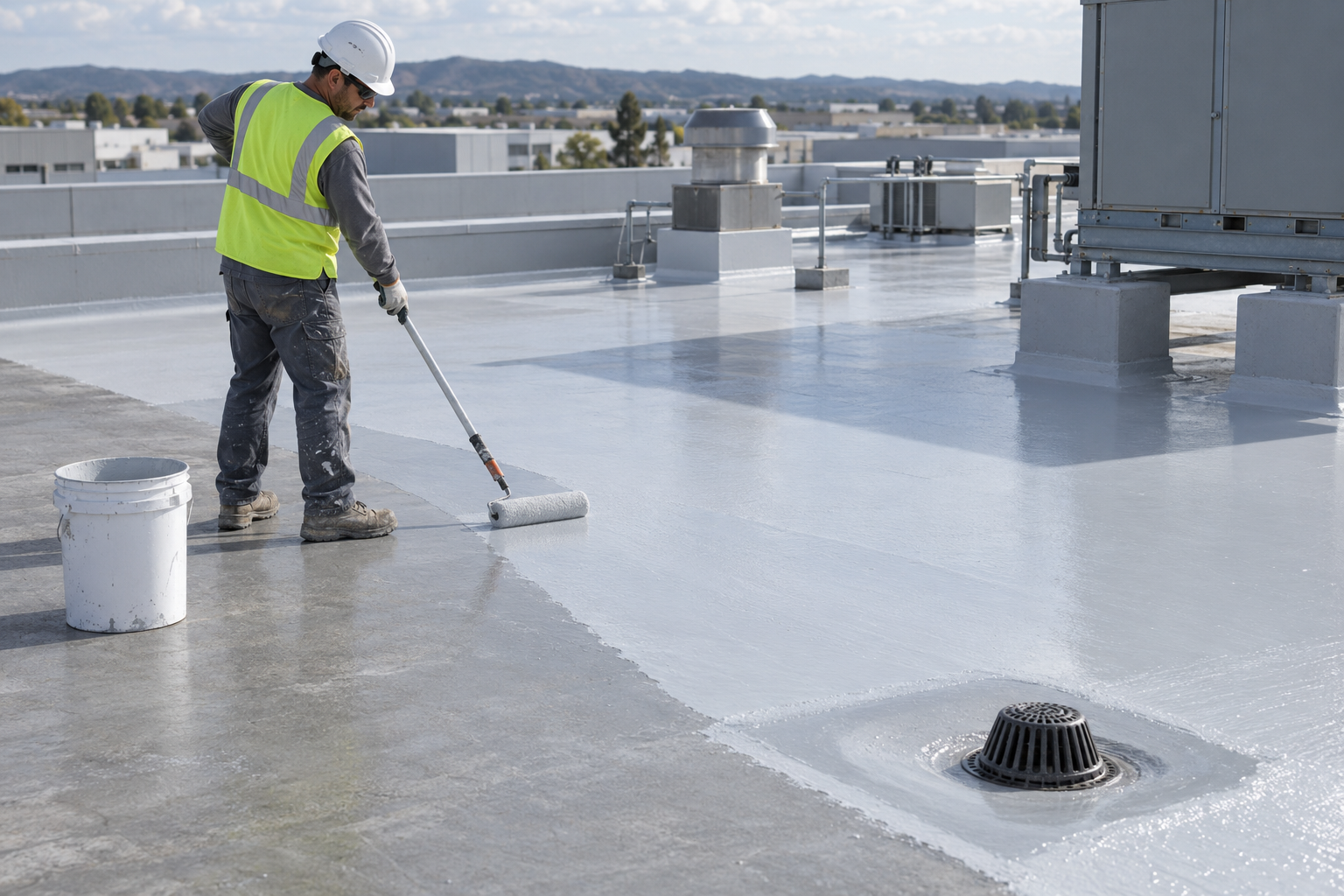
Exposed surfaces—roofs, balconies, podium decks, and parapets—are subject to continuous UV radiation, thermal cycling, rain, and mechanical abrasion. Standard acrylic coatings may degrade prematurely under these conditions unless specifically formulated for exterior durability. Unlike concealed or protected membranes, exposed acrylic coatings serve as both the waterproofing layer and the topmost protective finish. Their long-term integrity depends on formulation stability, film-forming consistency, and resistance to chalking, cracking, and delamination—not just initial water resistance.
Key Technical Selection Criteria
1. UV Resistance & Film Integrity
UV exposure accelerates polymer chain scission in acrylics, leading to embrittlement, color fading, and microcracking. While accelerated UV aging tests (e.g., ASTM G154 or ISO 4892-3) are widely used in the industry to assess durability, specific test results—including exposure duration, pass/fail criteria, and retention metrics—for any given product should be confirmed directly with the supplier. A durable exposed coating generally aims to retain strong tensile and elongation properties after extended UV exposure—but verified data must be requested per batch or product line.
2. Elongation & Crack-Bridging Capacity
Thermal movement and substrate settlement can induce hairline cracks in concrete or metal substrates. For exposed use, high elongation supports flexibility and helps accommodate minor movement. While many industry-standard acrylic coatings target elongation above 200% (measured per ASTM D412 or ISO 37), actual performance depends heavily on dry film thickness (DFT), substrate condition, and curing environment. Always confirm the manufacturer’s recommended DFT and application protocol—and verify whether crack-bridging claims apply to your specific substrate and expected movement profile.
3. Adhesion to Common Substrates
Exposed coatings must bond reliably to aged concrete, fiber cement, aged bitumen, and primed metal without edge lifting or blistering. Industry reference values—for example, adhesion ≥1.0 MPa on cured concrete (per ASTM D4541 or ISO 4624)—serve as useful benchmarks. However, real-world adhesion varies significantly with surface moisture, profiling method, primer selection, and ambient conditions. Request substrate-specific adhesion data where possible, and clarify whether testing was conducted on damp, dry, or primed surfaces.
Substrate Preparation & Application Realities
Even high-performance acrylic coatings fail if applied over improperly prepared surfaces. Critical checks include:
- Moisture content: Concrete substrates should meet accepted moisture thresholds—commonly ≤75% RH (per ASTM F2170) or ≤4% moisture by calcium carbide test (ASTM D4263)—prior to application. Field measurement is essential; lab-based assumptions are insufficient.
- Surface profiling: Mechanical abrasion (e.g., grinding or shot blasting) is often required for aged, smooth, or contaminated substrates—chemical cleaning alone rarely delivers long-term bond integrity.
- Primer compatibility: Not all acrylic coatings accept the same primer. Confirm primer type (e.g., acrylic-based vs. epoxy-modified), required cure time before topcoating, and compatibility with your substrate’s age and condition.
- Curing environment: Acrylics require stable ambient temperatures (typically 5–35°C) and relative humidity below 85% during application and initial cure. Low-temperature formulations exist but may affect final film properties—verify suitability for your climate and schedule.
Procurement & Supply Considerations
For wholesalers and procurement teams, consistent supply and documentation readiness directly affect project timelines and compliance risk:
- Batch consistency: Request batch-to-batch test reports (e.g., viscosity, solids content, pH) to support formulation stability across production runs—especially for multi-phase or long-duration projects.
- Packaging & shelf life: One-component acrylic coatings are sensitive to freezing and prolonged storage. Shelf life varies by formulation; confirm maximum unopened shelf life under recommended storage conditions—and note that opened containers typically require use within 24–48 hours.
- Documentation support: Verify availability of up-to-date Material Safety Data Sheets (SDS), technical data sheets (TDS), and English-language application guides. For international projects, ask whether multilingual documentation or localized technical support is available.
- OEM or private-label options: If branding or packaging customization is needed, confirm whether OEM services—including custom labeling, packaging formats, or formulation adjustments—are offered, and under what minimum order quantity (MOQ) and lead-time terms.
Risks & Limitations to Clarify Upfront
Acrylic coatings offer advantages in ease of application, low VOC profile, and UV stability—but they are not universally suitable. Key limitations to discuss early include:
- Ponding water exposure: Most standard acrylic coatings are intended for intermittent wetting—not sustained ponding or hydrostatic pressure. If drainage is unreliable, confirm whether the product carries a hydrostatic head rating—or consider alternative systems.
- Surface temperature limits: Performance may decline at sustained surface temperatures above 70°C. Avoid direct application over dark, non-reflective membranes without evaluating thermal buildup or adding a reflective topcoat.
- Chemical resistance: Acrylic films generally have limited resistance to hydrocarbons, strong solvents, and concentrated acids or bases. Clearly specify anticipated chemical exposure during procurement discussions.
- Recoat window: Over-recoating outside the specified window (e.g., >72 hours) may require mechanical re-profiling to ensure intercoat adhesion—confirm exact timing, surface prep, and compatibility requirements.
What to Request From Your Supplier
Before placing an order, obtain the following documentation and confirmations:
- Third-party test reports covering UV aging, adhesion (on relevant substrates), elongation, and water penetration resistance—dated and traceable to current product batches
- Batch-specific TDS and SDS, issued within the last 12 months
- Confirmed minimum and maximum application temperatures, recoat windows, and surface moisture tolerances
- Approved primer list and substrate-specific surface preparation checklist
- Sample availability, lead time for technical evaluation, and access to applicator training or site assessment support
For procurement teams managing multiple projects, ask whether technical support—including pre-application reviews or specification alignment—is included or available separately.
Next Steps for Procurement & Contracting Teams
If you are evaluating solutions for exposed waterproofing applications, begin by clarifying your project’s specific environmental exposure class, substrate condition, and documentation requirements. Then, request verified test data—not brochures—and validate compatibility with your current application protocols.
You can explore YSROOM’s one-component acrylic waterproof coating for technical specifications, packaging options, and sample availability. Contact the technical sales team to discuss substrate-specific validation, documentation packages, or OEM feasibility for your procurement volume.

