

 English
 简体中文
 Español
 Deutsch
 Français
 Bahasa Indonesia
 Malaysia
 Português
 Русский язык
 بالعربية
 Kiswahili
 বাংলা
 Why Application Method Matters in Polyurea Procurement
For protective coating contractors and industrial buyers, the choice between spray-applied and hand-applied polyurea is rarely about preference—it’s about alignment with project constraints. Factors like access limitations, ambient conditions, substrate geometry, labor skill level, and required throughput directly affect coating integrity, warranty eligibility, and total installed cost. This guide outlines objective technical and procurement distinctions to support informed specification and sourcing decisions.
Core Technical Differences
Spray-Applied Polyurea
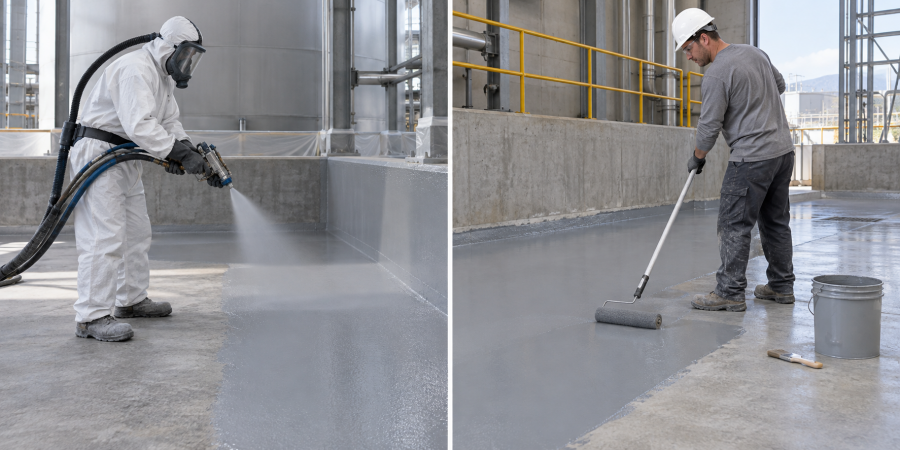
Spray-applied polyurea relies on high-pressure plural-component equipment to meter, mix, and atomize two reactive components (isocyanate and amine-terminated resin) at the gun tip. The reaction initiates within seconds, forming a continuous, seamless elastomeric film.
- Cure profile: Surface dry in
- Film thickness: Achieves uniform thickness from 1 mm to 5+ mm in a single pass; ideal for bridging minor substrate irregularities.
- Substrate compatibility: Requires clean, dry, and properly profiled concrete, steel, or primed membranes. Sensitive to surface moisture and ambient humidity above 85% RH unless formulated for damp-surface application.
- Equipment dependency: Requires trained operators, calibrated plural-component spray rigs, and compressed air or hydraulic power sources. Not suitable for confined or low-clearance areas without ventilation and safety controls.
Hand-Applied Polyurea
Hand-applied polyurea—typically supplied as a single-component, moisture-cured formulation—is applied using rollers, brushes, or squeegees. It cures via reaction with ambient moisture, eliminating the need for on-site mixing.
- Cure profile: Surface dry in 2–6 hours; tack-free in 8–24 hours; full cure typically requires 3–7 days at 23°C and 60% RH. Cure rate slows significantly below 10°C or above 90% RH.
- Film thickness: Applied in multiple thin coats (typically 0.2–0.4 mm per coat); cumulative thickness generally limited to 1.5–2.0 mm. Requires careful layering to avoid pinholes or solvent entrapment.
- Substrate compatibility: Tolerates moderate surface dampness better than spray systems, but still requires removal of standing water, laitance, and contaminants. Adhesion depends heavily on primer compatibility and mechanical profiling.
- Equipment dependency: Low—no specialized spraying equipment needed. Compatible with standard contractor tools. Suitable for vertical surfaces, overhead work, and tight-access zones where spray rigs cannot operate.
Project Suitability Comparison
Project Factor Spray-Applied Polyurea Hand-Applied Polyurea Large horizontal surfaces (e.g., tank roofs, plaza decks) Highly efficient—covers >500 m²/day with crew of 3–4 Moderate efficiency—covers ~100–150 m²/day with same crew Complex geometry (e.g., pipe penetrations, curbs, drains) Requires skilled masking and edge control; risk of overbuild or thin spots at transitions Greater manual control; easier detail work without overspray or rebound loss Ambient temperature range Optimal: 10–35°C; some formulations support down to 5°C with pre-heating Optimal: 15–30°C; unreliable below 10°C or above 35°C VOC compliance & indoor use Zero-VOC formulations available; requires ventilation during application due to aerosol generation Low-VOC options exist; lower airborne particulate risk makes it more suitable for occupied or ventilated-limited interiorsProcurement & Supply Considerations
From a distributor or contractor procurement standpoint, packaging, shelf life, and minimum order requirements influence inventory strategy and lead time planning.
- Spray systems are supplied in dual-component kits (e.g., 20L A + 20L B drums) or bulk totes. Shelf life is typically 6–12 months unopened when stored at 15–25°C. Component stability is sensitive to moisture ingress—drums must remain sealed until use.
- Hand-applied systems are commonly supplied in single-component pails (e.g., 20 kg or 25 kg units). Shelf life ranges from 9–18 months under dry, cool storage. No mixing ratios or component balancing required—simplifies on-site logistics and reduces material waste risk.
Both types require documentation support: SDS, TDS, and application guides should be available prior to ordering. Contractors should confirm whether primers are included or specified separately—and verify compatibility with existing substrates and adjacent materials (e.g., insulation, flashing).
Limits and Risk Mitigation
Neither method delivers consistent performance without proper execution:
- Spray-applied polyurea may delaminate if substrate profiling is insufficient or if ambient dew point is exceeded during application.
- Hand-applied polyurea may exhibit inconsistent cure or reduced elongation if film thickness exceeds manufacturer recommendations or if ambient humidity falls below 40% RH during cure.
- Both systems require adhesion testing per ASTM D4541 or EN 1542 on representative mock-ups before full-scale application—especially over repaired or non-standard substrates.
Contractors should request substrate-specific application protocols and conduct trial applications under actual site conditions. Where project specifications reference performance standards (e.g., tensile strength, elongation, water vapor transmission), confirm that the selected product formulation has been tested to those parameters—and that test reports are available upon request.
Next Steps for Buyers and Contractors
When evaluating options for your next protective coating project:
- Map site constraints first—access, ventilation, temperature/humidity forecast, and substrate condition.
- Compare labor availability and equipment access: Do you have certified plural-component operators? Is spray rig mobilization feasible?
- Review packaging format and shelf-life requirements against your project schedule and storage capacity.
- Confirm documentation support: Are TDS, SDS, and primer compatibility data provided? Is technical assistance available for application troubleshooting?
For project-specific guidance, consult technical documentation for the spray-applied polyurea waterproof coating and the hand-applied polyurea coating. Both products support industrial-grade waterproofing and corrosion protection—but optimal selection depends on your operational and environmental context.

